


This Headache Cannot be Treated with Aspirin- Beware of Warehouse Workers’ Headache!
A severe, persistent headache at work might seem routine, but in warehouses, it can signal a much more serious problem: carbon monoxide poisoning from propane forklifts. This silent, invisible, odorless gas can accumulate quickly in indoor spaces, putting workers at risk for long-term health problems.
Even when forklifts run on propane—a “cleaner” fuel compared to gasoline or diesel—workers are not immune from CO exposure. Without proper maintenance, ventilation, and monitoring, propane forklifts can silently endanger employees every day.
Propane Forklift CO Poisoning in Warehouses
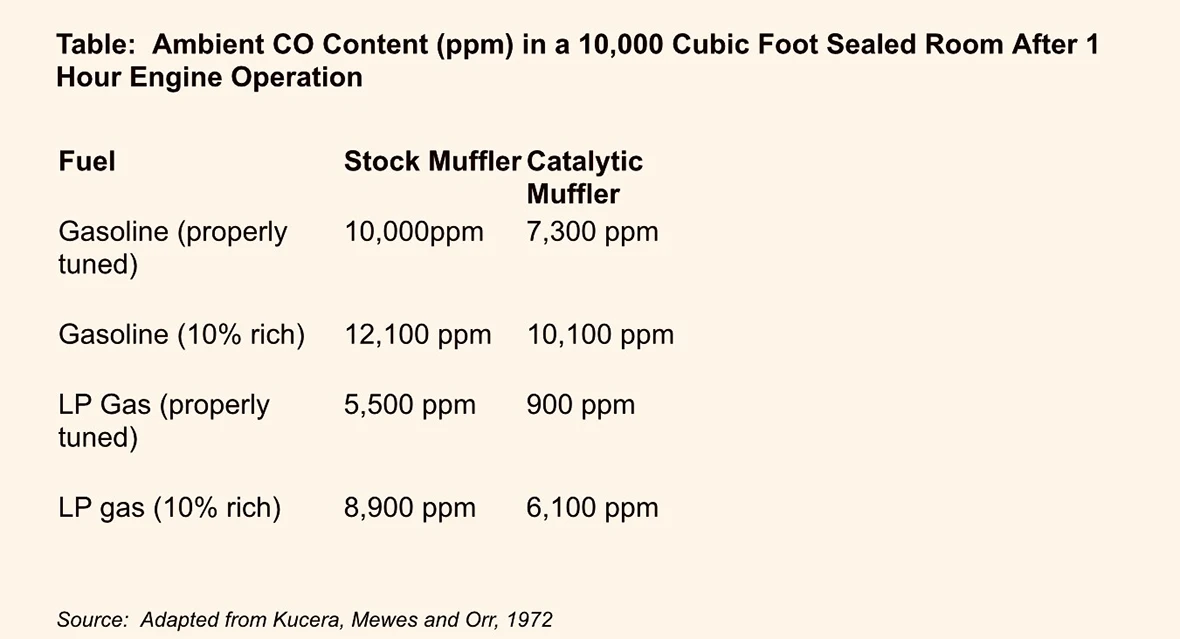 A severe headache is the most common symptom of CO poisoning. In warehouse environments, repeated exposure has led to a condition informally called Warehouse Workers’ Headache Syndrome.
Many warehouse operators assume that propane forklifts eliminate CO risks. While propane burns cleaner than diesel or gasoline, it can still produce carbon monoxide if:
- The forklift is poorly maintained
- Catalytic converters are missing or malfunctioning
- The engine is left idling indoors near ventilation intakes
Case example
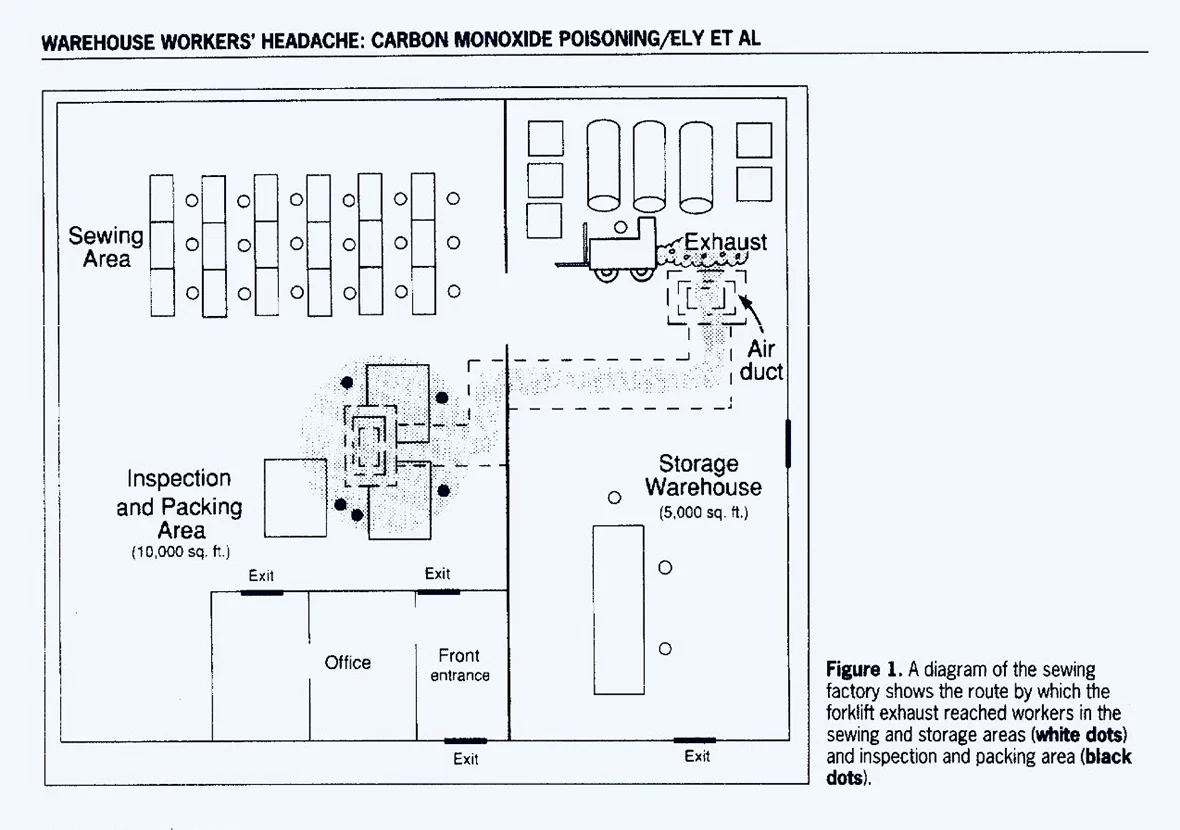 At a small storage warehouse, a gasoline forklift was converted to propane due to safety concerns. The forklift was left idling near an air intake, causing CO exposure to 3 male and 27 female employees. Some were still suffering neurological effects—numbness in limbs, confusion, memory loss, persistent headaches—two years later (Ely, Moorehead & Haponik, 1995).
The layout of the warehouse is shown below:
Investigators measured the CO concentration in the room at 386 ppm while the propane forklift idled. Once turned off and ventilated, levels dropped to 3 ppm within minutes, demonstrating how quickly CO can accumulate and dissipate indoors.
Electric Forklifts Eliminate CO Risk
Electric forklifts are completely safe from carbon monoxide because they produce no combustion emissions.
A tragic example illustrates the danger of combustion-powered forklifts in enclosed spaces. In one warehouse operation, a propane-powered forklift was used to load pallets of blueberries into a refrigerated truck. During the operation, two employees lost consciousness due to carbon monoxide exposure, and one worker later died with a carboxyhemoglobin (COHb) concentration of 60%, a level associated with severe and often fatal poisoning. Following the incident, the propane forklift was replaced with an electric model, eliminating the CO hazard associated with that equipment.
The authors of this investigation (Hirsch, Langley, and McDaniel, 2016) emphasized that while electric forklifts are the safest option for indoor environments, not all workplaces can immediately replace combustion-powered machinery. In such situations, employers can significantly reduce the risk of carbon monoxide exposure by implementing several practical safety measures.

..they can reduce CO exposure by limiting the amount of time combustion equipment is used indoors, providing adequate ventilation, installing CO alarms, keeping combustion equipment properly maintained, and educating employees on the symptoms of CO poisoning.
Hirsch, Langley, and McDaniel, 2016

These precautions are not limited to propane forklifts. Similar risks exist with portable propane heaters and gas-powered equipment, including heavy-duty saws, grinders, and floor polishers used indoors or in poorly ventilated environments. Without proper ventilation and monitoring, these devices can also generate dangerous carbon monoxide levels and place workers at serious risk.
Long-Term Risks and Prevention
Repeated CO exposure can cause chronic neurological symptoms, including headaches, dizziness, confusion, memory impairment, and numbness. Early identification of Warehouse Workers’ Headache Syndrome is essential to prevent serious injury or death.
The encouraging reality is that this hazard is largely preventable. Proper equipment maintenance, improved ventilation, worker education, and the installation of inexpensive carbon monoxide detectors can dramatically reduce the risk.
With awareness and simple safety measures, the dangerous headache caused by carbon monoxide exposure can disappear—just as quickly as the gas itself does when a warehouse is properly ventilated.
References
Carbon Monoxide in Warehouses
Understand the Risk Behind the Headache
Persistent headaches in warehouse workers may be an early warning sign of carbon monoxide exposure from propane equipment. To better understand how this invisible gas affects the body—and how these cases are investigated—explore the science and real-world evidence in Wigmore on Carbon Monoxide by James Wigmore.
Get the BookLearn how carbon monoxide exposure is detected, interpreted, and prevented in occupational settings.
Propane Forklift: FAQs
Can a propane forklift cause carbon monoxide poisoning?
Yes. Even though propane burns cleaner than gasoline, poorly maintained or idling forklifts can produce dangerous CO levels indoors.
What is Warehouse Workers’ Headache Syndrome?
Persistent headaches and neurological symptoms caused by repeated carbon monoxide exposure in warehouses.
Why are propane forklifts dangerous indoors?
Carbon monoxide from combustion engines accumulates in poorly ventilated spaces, endangering workers.
What are the symptoms of CO exposure in warehouses?
Severe headaches, dizziness, confusion, nausea, memory loss, numbness, and in severe cases, unconsciousness.
Are electric forklifts safer than propane forklifts?
Yes. Electric forklifts produce no CO and are the safest option for indoor warehouse operations.
Recent News

This Headache Cannot be Treated with Aspirin- Bewa...
A severe, persistent headache at work might seem routine, but in warehouses, it can signal...
Read More
Carbon Monoxide and Ghosts
Carbon monoxide(CO) has been an ancient, silent enemy of humans for thousands of years. Its...
Read More
Nicotine as a Chemical Weapon?
E cigarette liquid nicotine is not just a vaping product—it is one of the most potent...
Read More
Impaired Driving Cases: Rats Don’t Drive
Impaired driving prosecutions require expert testimony grounded in human physiology, not animal studies. Occasionally humour...
Read More