


Research Update: The Effects of Alcohol on Postmortem Bladder Urine Volume
“And now for something completely different.”
Is postmortem bladder urine volume an indication of alcohol/drug intoxication? A reasonable question given that alcohol is a well-known diuretic (i.e., increases urine formation by the kidneys) as anyone can attest to if you’ve ever sat near the restrooms in a bar! The average production of urine is approximately 0.55 to 1.25 mL/min but during the consumption of alcohol it can increase nearly 10X to between 7-12 mL/min. The profound effects of alcohol as a diuretic are a critical starting point for understanding postmortem findings.
Generally, the desire to void occurs when 150 mL of urine is in the bladder and pronounced discomfort usually occurs at a urine volume of 450 mL (WOA40401). Interestingly, the diuretic effects of alcohol decrease after drinking ends. Within 2 hours after it ceases, the production of urine returns to normal even though the BAC may still be high (WOA40402). This temporal pattern is crucial for interpreting bladder contents at time of death.
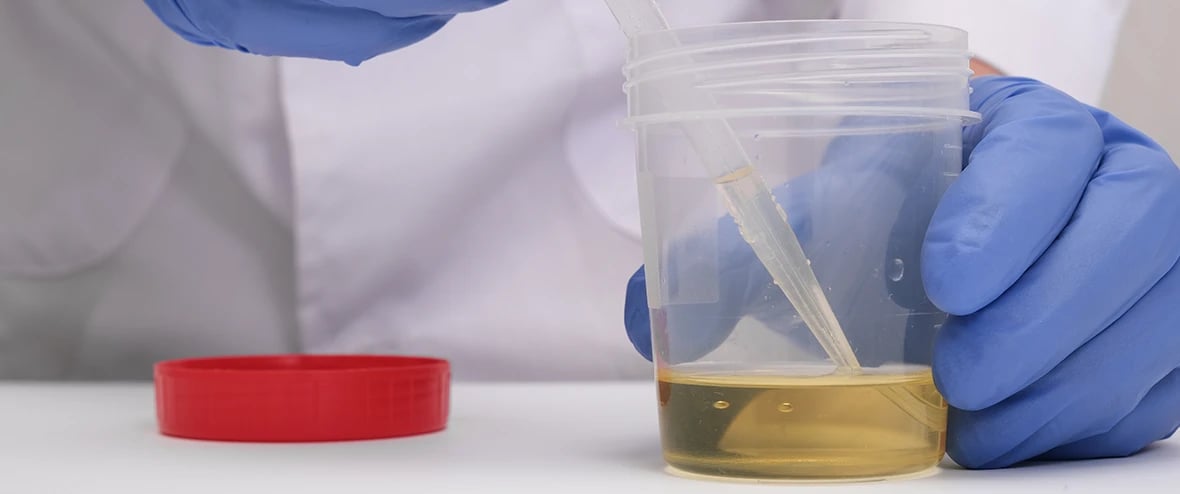
Alcohol and the Risk of Bladder Rupture
One adverse consequence of the diuretic and impairing effects of alcohol is that there is an increased risk of a painful bladder rupture after minor trauma (e.g., ground level fall, punch to abdomen). One study found that: “Alcohol intoxication increases the risk of bladder rupture by several means. Intoxication decreases the sensation of, and the behavioural response to bladder filling. Both the sheer volume of alcohol and its diuretic effect increases bladder filling, often to the point of massive overdistensions. This overdistension may lead to an atonic decompensated bladder so stretched and thinned that even minor trauma may cause it to rupture.” (WOA40109)
It was originally thought that this type of alcohol-related bladder rupture occurred only in men but another recent study (WOA402U1) reported three women who attended hospital who developed lower abdominal pain after binge drinking. It was later determined that they all had suffered idiopathic rupture of the bladder, highlighting a dangerous and often overlooked outcome of intoxication.
Bladder Volume as an Intoxication Marker
Traditionally, urinary bladder distension at autopsy has been regarded as a sign of intoxication of the deceased, but little scientific studies have been conducted in this area. A recent study, however, has given scientific proof of this observation, specifically linking bladder volume to the effects of alcohol and drugs. The study and citation are:
Rohner, C., S. Franckenberg, N. Schwendener, A. Oesterich, T. Kraemer, M.J. Thali, G.M. Hatch and T.D. Ruder., “New Evidence for Old Lore – Urinary Bladder Distension on Post-Mortem Computed Tomography is Related to Intoxication”, Forensic Science International, 225: 48-52, 2013 [1 table, 5 figures, 17 references]
The bladder urine volume, determined physically at autopsy by the pathologist, was compared with the urine volume calculated by computed tomography (CT) in 259 autopsy cases. Autopsy and toxicology reports in these cases were evaluated to determine if there was any correlation between urine volume at autopsy and alcohol/drug intoxication of the deceased.
The study’s key findings include:
- The mean difference between measured urine volume and CT computed urine volume was only 0.8 mL with a strong correlation (r=0.92).
- The mean volume of urine increased significantly with alcohol/drug intoxication.
- The mean urine volume was greatest in cases where a fatal alcohol/drug intoxication occurred.
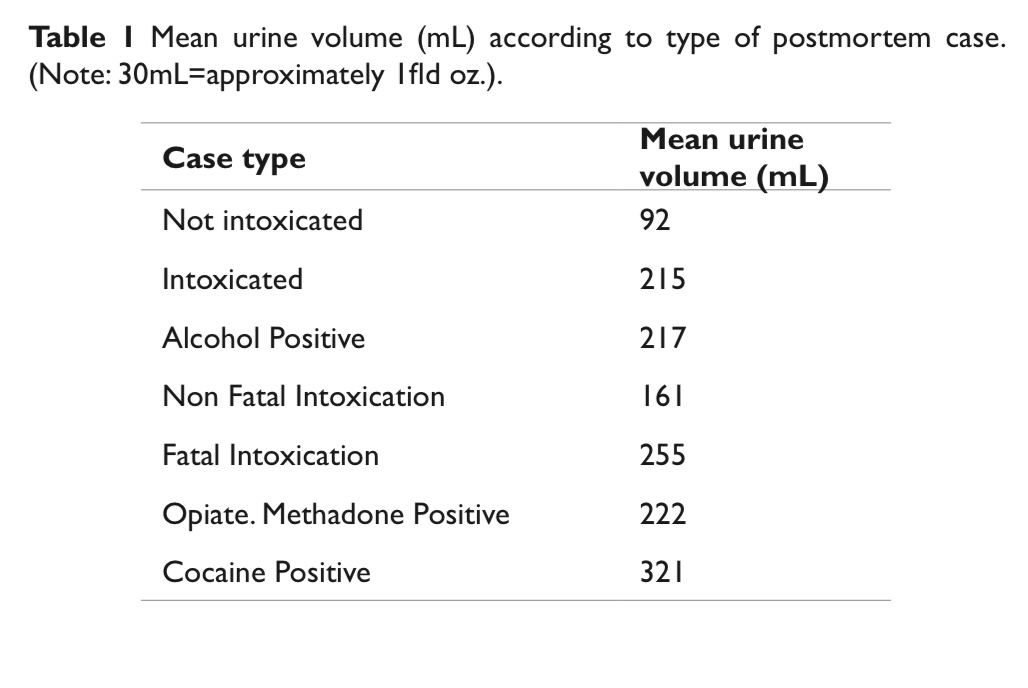
The research established critical cutoff volumes:
- Using a 182 mL cutoff showed 40% sensitivity and 87% specificity for detecting intoxication.
- A higher 330 mL cutoff decreased sensitivity to 25% but increased specificity to 97%.
The authors concluded: “We have found that CT provides a reliable method to quantify urinary bladder volume. In our population, there was a statistically significant correlation between urinary bladder distension on the post-mortem CT and cases of intoxication. This means that the occurrence of urinary bladder distension as single finding on post-mortem imaging should raise suspicion of intoxication and result in subsequent toxicological analysis.”
Implications and Conclusions for Forensic Practice
This recent study has shown that the old lore of postmortem urinary bladder distension and alcohol/drug intoxication in the deceased was correct. Postmortem bladder urine volume may provide a preliminary screening tool for the busy pathologist, coroner, medicolegal examiner and forensic toxicology labs. It also may detect cases in which there was no prior suspicion of alcohol /drug intoxication, directly informed by understanding the diuretic effects of alcohol. Of course more research into this area is required, and toxicological findings should not be based on urine volume alone. This study may be obtained at www.sciencedirect.com.
*All the references cited may be found in WOA 2E in the appropriate section according to the number.”
Act Now: Strengthen Your Forensic Assessments
Put Science Behind Your Interpretation of Bladder Findings
Forensic professionals know that effects of alcohol go beyond simple metabolism — they influence physiological markers that can matter at autopsy. Rather than relying on folklore, use scientifically validated correlations between bladder volume and intoxication to support your practice.
Get a Free Expert Consultation TodayTrusted forensic toxicology guidance from Wigmore on Alcohol experts.
Effects of alcohol: FAQs
What are the primary effects of alcohol on urine production?
Alcohol is a potent diuretic, which can increase urine production from a normal rate of 0.55-1.25 mL/min to as high as 7-12 mL/min.
How long do the diuretic effects of alcohol last?
The diuretic effect decreases after drinking stops, and urine production typically returns to normal within 2 hours, even if blood alcohol concentration remains elevated.
Can alcohol consumption lead to bladder rupture?
Yes, intoxication increases the risk. Alcohol causes overfilling and decreases sensation, making a distended, thinned bladder vulnerable to rupture from minor trauma.
What did the 2013 Rohner et al. study conclude about bladder volume and intoxication?
It found a statistically significant correlation between postmortem urinary bladder distension and cases of alcohol or drug intoxication, validating it as a reliable indicator.
What bladder volume cutoff suggests possible intoxication according to the study?
The study suggested a cutoff of 182 mL, which provided 87% specificity for detecting intoxication.
Is a distended bladder at autopsy definitive proof of intoxication?
No, it is a preliminary indicator that should raise suspicion and prompt toxicological analysis, not serve as sole evidence.
Why is CT scanning useful in this context?
CT provides a reliable, non-invasive method to quantify bladder volume before autopsy, with a very high correlation to physically measured volumes.
Who can use bladder volume as a screening tool?
Pathologists, coroners, medicolegal examiners, and forensic labs can use it as an initial screening indicator for potential intoxication.
Recent News

Postmortem Diffusion of Alcohol and Trauma
Postmortem diffusion of alcohol from the stomach into the surrounding blood and tissues can occur...
Read More
Once More Into the Breach: Junkert Impaired Drivin...
Some DWI cases change the legal landscape forever. The Junkert case is one of them....
Read More
Melbye and Me
The field of forensic anthropology in Canada owes much to one man: Dr. Melbye. He...
Read More
Niagara Falls, I Thought It Would be Bigger!
Some professional relationships transcend borders and decades. As a forensic toxicologist, I have been fortunate...
Read More