


Does Workplace Cannabis Use Increase the Risk of Injury?
A critical new study provides essential data on cannabis use and workplace safety, revealing a clear distinction between consumption during and outside of work hours. While cannabis is now legal in Canada and many U.S. states, its impact in the workplace remains a significant concern for employers. The controversy stems from changing legal landscapes where the presence of cannabis alone is no longer valid grounds for dismissal, making evidence-based policy more important than ever.

Key Findings from the Canadian Workplace Study
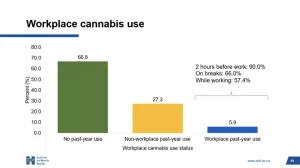 The findings come from a robust, yearly longitudinal telephone survey of 2,745 Canadian workers conducted between 2018 and 2020. Researchers investigated past-year habits, specifically separating workplace and non-workplace cannabis use.
- Workplace Consumption: Defined as cannabis use during working hours (including breaks) or within 2 hours before starting work.
- Non-Workplace Consumption: All other use outside the defined work-related window.
The study recorded that 11.3% of all workers experienced a workplace injury during the period. This figure broke down significantly by job type:
- 22.0% of workers in safety-sensitive positions reported an injury.
- 4.9% of workers in non-safety sensitive jobs reported an injury.
Notably, injuries occurring in safety-sensitive environments tended to be more severe, underscoring the higher stakes in those roles.
The Direct Link: How Workplace Cannabis Use Doubles Risk
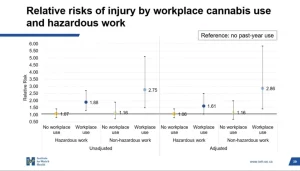 The core discovery of the research is stark. Analysis showed no statistically significant difference in injury risk for workers who engaged in non-workplace cannabis use compared to non-users. In dramatic contrast, workplace consumption was associated with a nearly two-fold (2X) increase in the risk of sustaining a workplace injury.
This key finding held true across different work environments. The pattern of increased risk for use at work, but not for external use, was consistent for employees in both safety-sensitive and non-safety sensitive positions. This strongly suggests the impairment effect of THC during work tasks is the primary driver of accidents, not the general status of being a consumer.
Implications for Policy and Safety
These findings carry substantial weight for employers crafting policies. They validate legitimate concerns about impairment during work hours but also challenge the scope of some existing rules.
- The data indicates that zero-tolerance policieswhich prohibit all cannabis use—including during an employee’s personal time—may be overly broad and not fully aligned with the evidence on where the actual risk lies.
- The study substantiates the need for targeted worker education programs. These should specifically highlight the risks of consuming cannabis before or during shifts.
Expert Context: Forensic Science and Workplace Safety
The study’s conclusions resonate with the work of leading forensic scientists who analyze the real-world impacts of substance use. James Wigmore, one of North America’s most experienced toxicology experts, has contributed groundbreaking analysis on alcohol, cannabis (THC), and other substances over a 29-year career at Toronto’s Centre of Forensic Sciences. His expertise, spanning over 700 criminal cases, includes:
- Developing court-accepted methodologies for impairment assessment.
- Publishing definitive research on THC detection and impairment markers.
- Shaping public understanding through media commentary following legalization.
This scientific perspective underscores why distinguishing between workplace and non-workplace cannabis use is not just a policy issue, but a matter of accurate risk assessment based on forensic principles.
References
Injured at Work? Cannabis Use Could Affect Your Claim
Forensic Science Reveals How Workplace THC Consumption Impacts Injury Liability
The 2026 Canadian study proves workplace cannabis use doubles injury risk—but consumption outside work hours shows no increased risk. This critical distinction can make or break workplace injury claims and liability determinations. James Wigmore’s forensic team analyzes how THC detection timelines and impairment markers specifically relate to on-the-job incidents versus personal use. Our expertise helps clarify whether cannabis was a contributing factor in your workplace injury case.
Get a Free Case EvaluationDon’t let ambiguous cannabis evidence jeopardize your injury claim or workplace rights. Contact our forensic experts today.
FAQs on Workplace Cannabis Use and Safety
Does using cannabis outside of work increase my risk of injury at work?
According to this Canadian study, no. It found no increased injury risk associated with non-workplace cannabis use.
How is "workplace cannabis use" defined in the study?
It is defined as consuming cannabis during working hours, including breaks, or within 2 hours before the start of a work shift.
What was the increase in injury risk for workplace cannabis use?
The study found a nearly two-fold (2X) increase in the risk of a workplace injury.
Were safety-sensitive jobs at higher risk?
Overall, 22% of workers in safety-sensitive jobs reported an injury (compared to 4.9% in other jobs), but the relative increase in risk from workplace cannabis use was similar across job types.
What does this mean for employer drug policies?
The study suggests policies should distinguish between use during and outside of work, as the injury risk is specifically linked to impairment during work hours.
Who conducted this research?
The study was published in the Canadian Journal of Public Health by researchers including Carnide, N., Landsman, V., and Smith, P.M. in 2023.
Does this mean cannabis is safe to use before work?
Absolutely not. The study clearly shows using cannabis before or during work significantly increases your chance of being injured.
How many workers were in the study?
The research followed 2,745 Canadian workers over a two-year period from 2018 to 2020.
What is the main takeaway for employees?
The critical safety takeaway is to strictly avoid any cannabis use in the hours leading up to and during your work shift to minimize personal injury risk.
Recent News
Cannabis and Alcohol and Driving: 1+1 =3?
When it comes to driving impairment, the combination of alcohol and cannabis is far more dangerous than...
Read More
A Tragic Cannabis-Related Fatal Motor Vehicle Coll...
A sunny June afternoon. A minivan stopped at a red light. Inside: a mother and...
Read More
Cannabis, Alcohol and Suicide
Does daily cannabis use put your mental health at risk? New forensic research reveals a...
Read More
The Myth of “Next Day” Effects After S...
The debate about impairment after smoking cannabis often extends into the next day. A rigorous...
Read More