


Two Great Bookends for a Career
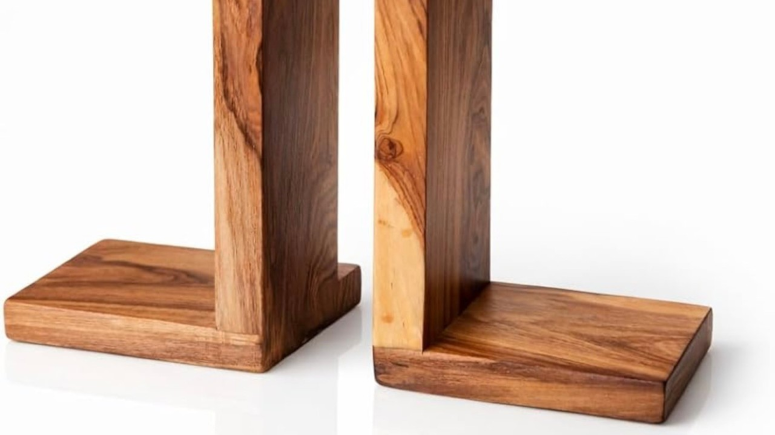
Brian O’Marra and I had had similar parallel careers which crossed several times over the years, when he was a crown attorney and conducted several trials that I was involved with as a forensic toxicologist. The most notable together was the early trial of R vs McVeigh in 1983, when he was a junior crown attorney and I was a junior forensic toxicologist. That driving under the influence case, and the Ramage case that closed my career, became the two bookends of a life spent in driving under the influence work.

McVeigh and Ramage. What great bookends for a career.
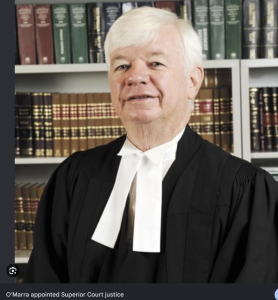
Ontario Superior Court Justice Brian O'Marra

R vs McVeigh
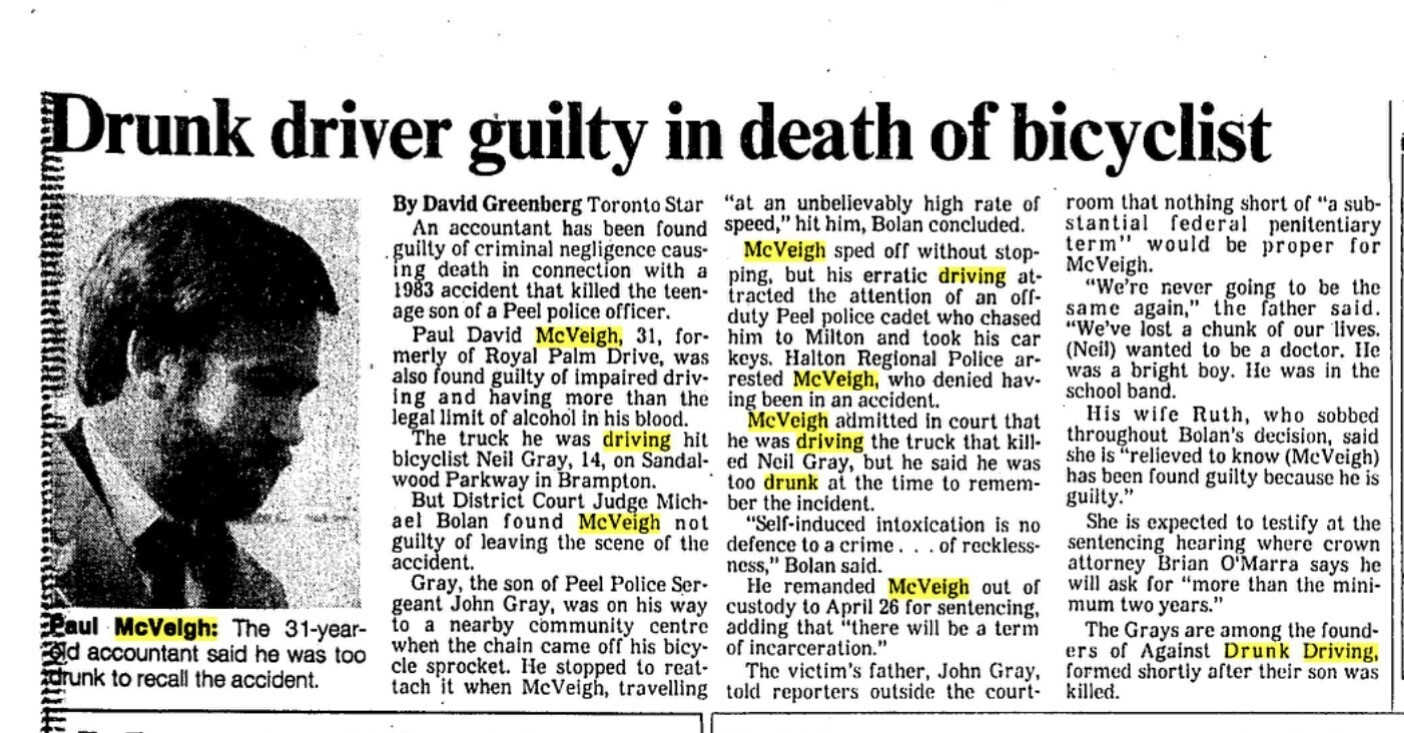 On April 1st, 1983, Paul David McVeigh, who was “very drunk”, struck and killed a 14 year old boy, the son of a Peel Police officer, who was sitting on his bicycle trying to repair the chain under a street lamp on a well-lit street.
I analysed the blood from Mr. McVeigh taken some 3 hours after the motor vehicle collision and found it contained 150 milligrams of alcohol in 100 millilitres of blood and could have been as high as 210 mg/100mL at the time of the MVC.
This is one of the earliest major driving under the influence cases I had, and I testified as to the BAC of Mr. McVeigh, impairment of driving, and risk of MVC with increasing BAC.
The Toronto Star reported that McVeigh, 31, an accountant, was found guilty of criminal negligence causing death, impaired driving, and having more than the legal limit of alcohol in his blood. He was found not guilty of leaving the scene. He admitted driving the truck that killed Neil Gray but said he was too drunk to remember. The judge stated: “Self-induced intoxication is no defence to a crime . . . of recklessness.”
The victim’s father, John Gray, told reporters that nothing short of “a substantial federal penitentiary term” would be proper. The Grays were among the founders of Against Drunk Driving, formed shortly after their son was killed.
R vs McVeigh Appeal
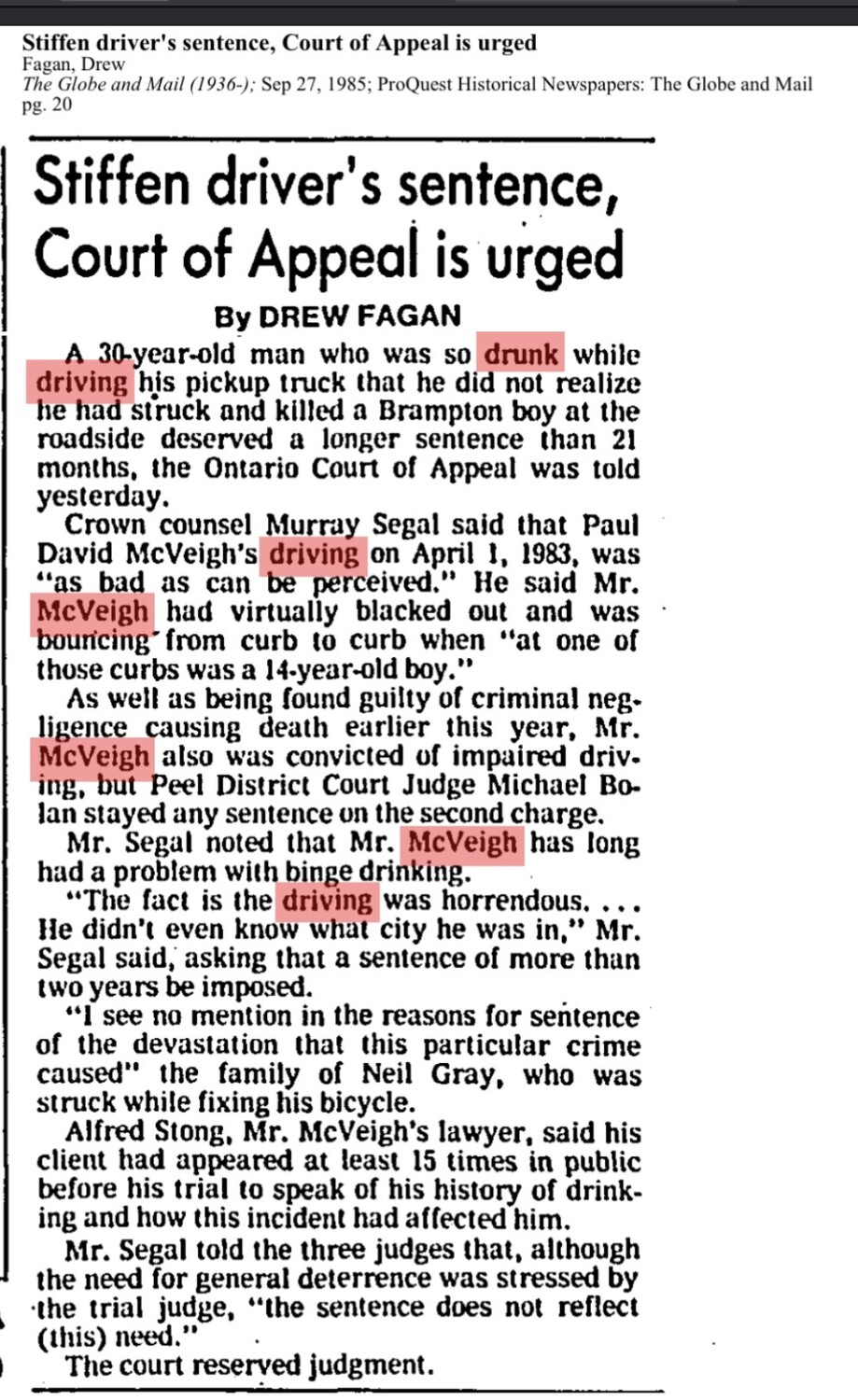 McVeigh was given a 21 month sentence by the judge, which could be served in a provincial institution intermittently on weekends. There was wide public outcry about how lenient the sentence was, and it was appealed by the crown to the Court of Appeal.
It is interesting that the crown appeal was conducted by Murray Segal, who became the Deputy Attorney General of Ontario and who I met numerous times later, to write chapters in his book on Breathalyzer Law in Canada after I had retired from the Centre of Forensic Sciences.
The judges ruled that a 3 year sentence was more appropriate and R vs McVeigh became a foundational precedent for sentencing in driving under the influence cases for decades.
Why R vs McVeigh Still Matters
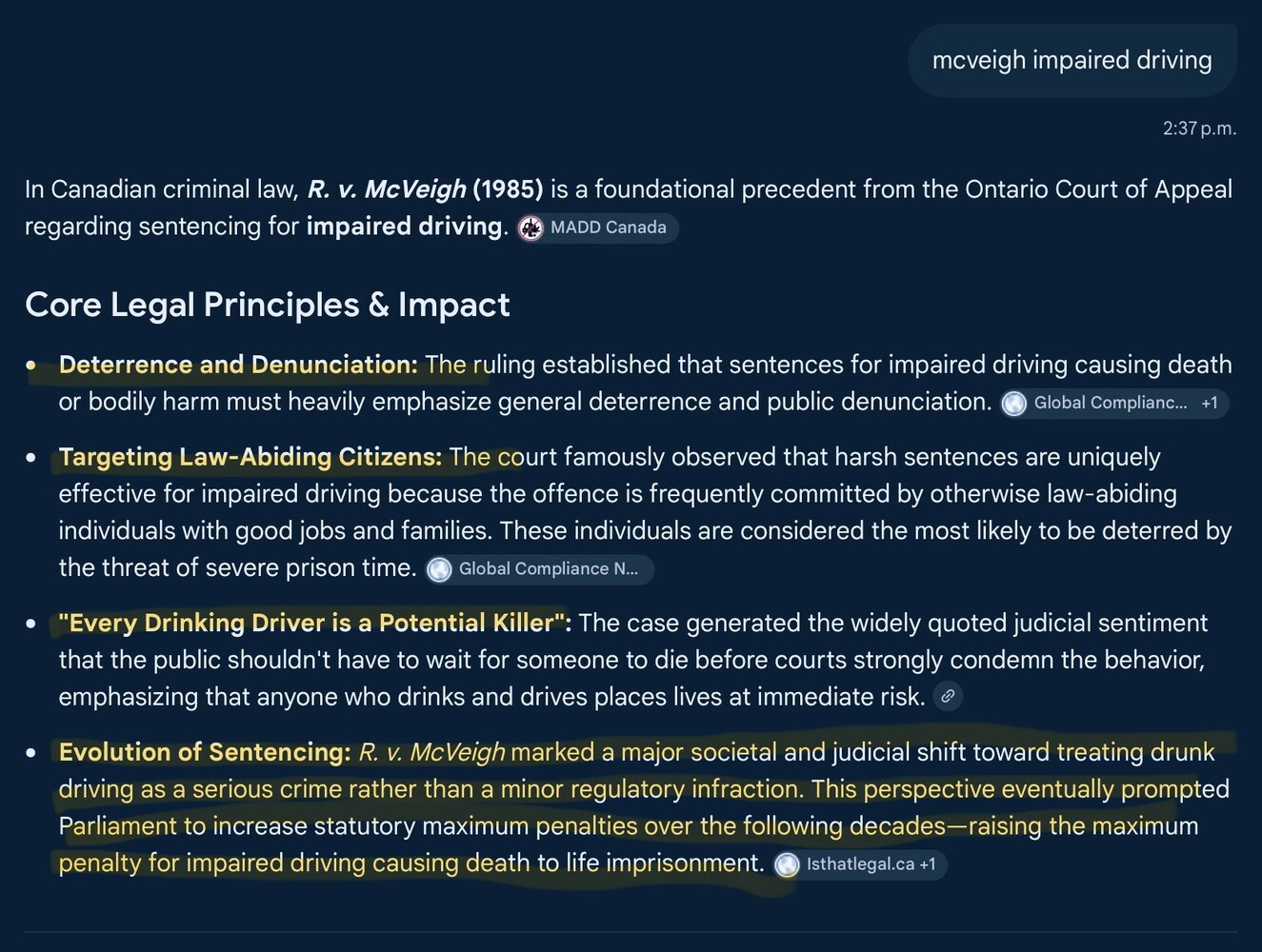 R vs McVeigh did more than settle one sentence. It changed how Canadian courts approached driving under the influence as a whole.
- Deterrence and denunciation. Sentences for impaired driving causing death or bodily harm must heavily emphasize general deterrence and public denunciation.
- Targeting law-abiding citizens. Harsh sentences are uniquely effective for driving under the influence because the offence is frequently committed by otherwise law-abiding individuals with good jobs and families, who are the most likely to be deterred by severe prison time.
- “Every drinking driver is a potential killer.” The public should not have to wait for someone to die before courts strongly condemn the behaviour.
- Evolution of sentencing. The case marked a shift toward treating driving under the influence as a serious crime rather than a minor regulatory infraction, eventually prompting Parliament to raise the maximum penalty for impaired driving causing death to life imprisonment.
Justice of Superior Court of Ontario Induction
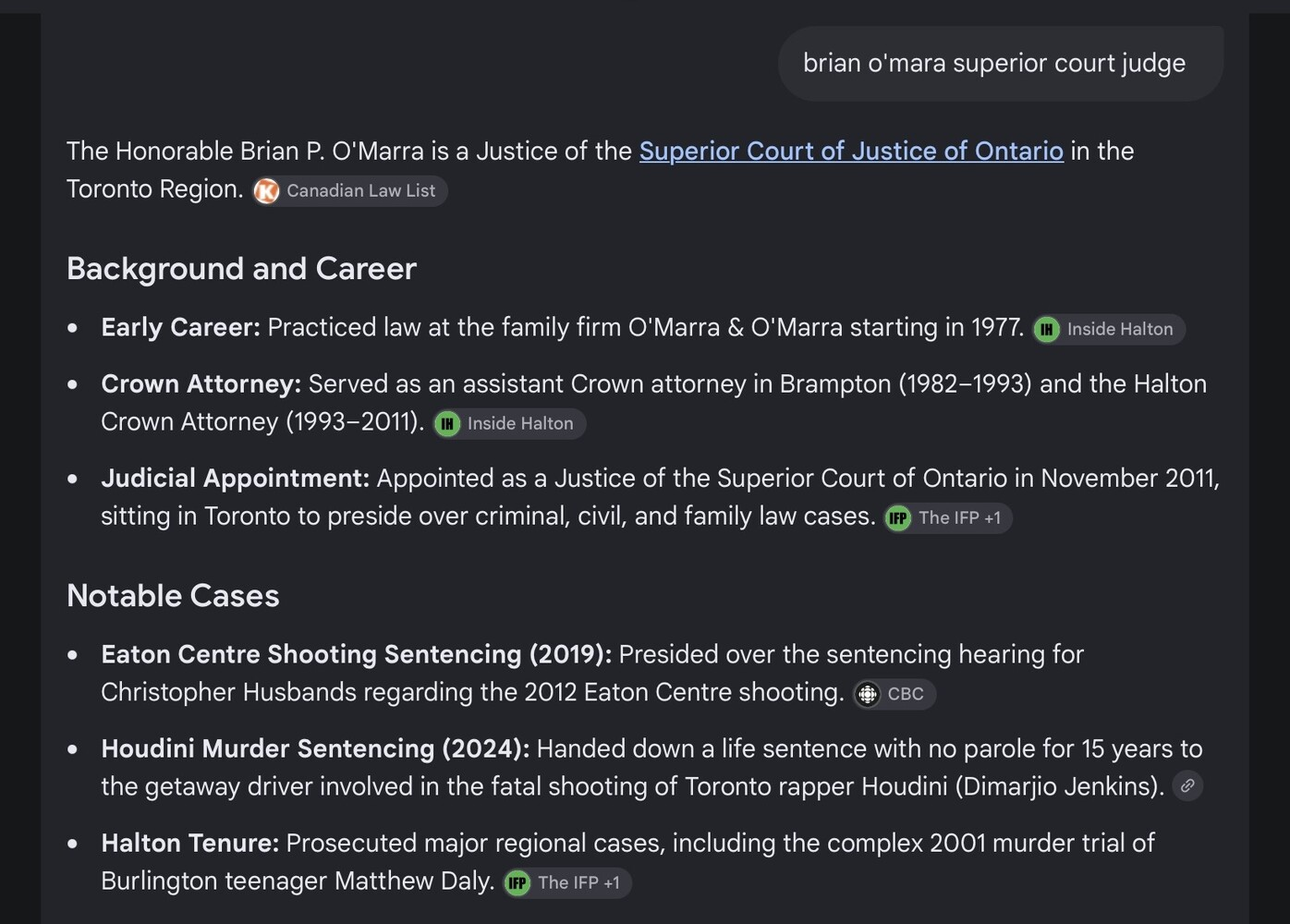 Brian invited me to his induction at the University Ave courthouse on Wednesday November 2nd, 2011. It was quite an honour and I got to see the induction of a Superior Court Justice of Ontario. The highlights of his career were read out.
The Honourable Brian P. O’Marra practised law at the family firm O’Marra & O’Marra starting in 1977. He served as an assistant Crown attorney in Brampton from 1982 to 1993, then as the Halton Crown Attorney from 1993 to 2011, before his appointment to the Superior Court of Ontario in November 2011. His notable cases include the Eaton Centre shooting sentencing in 2019 and the Houdini murder sentencing in 2024.
During the ceremony, his black lawyer robes were removed and replaced with the robes of a Senior Court Justice of Ontario. Afterwards, Justice O’Marra came up to me and said: “McVeigh and Ramage. What great bookends for a career.”
Three Rules for Superior Court Justices of Ontario
 During the induction ceremony the chief justice told Brian the 3 rules of a Superior Court Justice:
- Be prompt
- Be polite
- Be respectful
Which I thought are good rules for everyone to follow. They are also, in their way, good rules for anyone called to testify in a driving under the influence case.
R vs Ramage
The other criminal court bookend of my career was the case of Rob Ramage, a former NHL hockey player and captain. Where McVeigh opened my career as a junior toxicologist in 1983, Ramage closed it decades later as a senior expert.
Both cases turned on the same scientific question I had spent a career answering: what was the driver’s blood alcohol concentration at the time of the collision, and what did that mean for impairment? Both were prosecuted under the same body of driving under the influence law that R vs McVeigh helped create. And both were argued in courtrooms where the stakes could not have been higher.
The full judgment in R vs McVeigh is available at R v McVeigh, Ontario Court of Appeal, MacKinnon A.C.J.O., Goodman and Finlayson JJ.A., October 29, 1985.
Two cases, one at each end of a career. Justice O’Marra was right. What great bookends.
Contact an Expert in Driving Under the Influence Cases
Consult Canada's Leading Forensic Toxicologist
James Wigmore testified in R vs McVeigh, the case that became a foundational precedent for driving under the influence sentencing in Canada. With 50 years of experience and over 700 criminal cases, he provides expert insight for legal professionals.
Contact James Wigmore TodayPut 50 years of forensic expertise on your side. Reach out now for expert consultation.
FAQs on Driving Under the Influence and R vs McVeigh
What was R vs McVeigh about?
Paul David McVeigh, heavily intoxicated, struck and killed 14-year-old Neil Gray, who was repairing his bicycle at the roadside in Brampton on April 1st, 1983.
What was McVeigh's blood alcohol concentration?
The blood sample taken about 3 hours after the collision contained 150 mg/100mL and could have been as high as 210 mg/100mL at the time of the collision.
What was the original sentence?
A 21 month sentence, which could be served intermittently on weekends in a provincial institution.
Why was the sentence appealed?
There was wide public outcry about how lenient it was, and the Crown appealed to the Ontario Court of Appeal.
Who argued the Crown appeal?
Murray Segal, who later became Deputy Attorney General of Ontario and asked Wigmore to write chapters for Breathalyzer Law in Canada.
What sentence did the Court of Appeal impose?
Three years.
Why is R vs McVeigh important for driving under the influence law?
It became a foundational sentencing precedent, emphasizing general deterrence and denunciation, and treating impaired driving as a serious crime rather than a minor infraction.
Who was Brian O'Marra?
A Crown attorney who prosecuted R vs McVeigh as a junior, later Crown Attorney in Halton, and appointed a Justice of the Superior Court of Ontario in November 2011.
What are the three rules for Superior Court Justices of Ontario?
Be prompt, be polite, be respectful.
What was the other bookend of Wigmore's career?
The Rob Ramage case, involving a former NHL player and captain.
Recent News
Two Great Bookends for a Career
Brian O’Marra and I had had similar parallel careers which crossed several times over the...
Read More
The Making of Wigmore on Alcohol: A Journey for Ov...
I joined the Centre of Forensic Sciences in Toronto on February 16th, 1976, as a...
Read More
Melbye and Me
The field of forensic anthropology in Canada owes much to one man: Dr. Melbye. He...
Read More
Niagara Falls, I Thought It Would be Bigger!
Some professional relationships transcend borders and decades. As a forensic toxicologist, I have been fortunate...
Read More