


Cannabis and Alcohol and Driving: 1+1 =3?
When it comes to driving impairment, the combination of alcohol and cannabis is far more dangerous than either substance alone. This is not simply 1+1=2. It is 1+1=3 – a synergistic effect that multiplies impairment and crash risk. A new study published in JAMA Network Open in 2026 has confirmed what forensic toxicologists have long suspected: combining alcohol and cannabis produces impairment greater than the sum of its parts.
The study examined the effects of cannabis edibles combined with alcohol and cannabis on driving ability, using cutting-edge driving simulators and standardized field sobriety tests. The results have significant implications for public safety, legal limits, and how we understand the interaction between alcohol and cannabis in impaired driving cases. This research, conducted on 25 healthy adults, demonstrates that current legal limits in many jurisdictions may not adequately protect the public when alcohol and cannabis are co-used.
Table of Contents
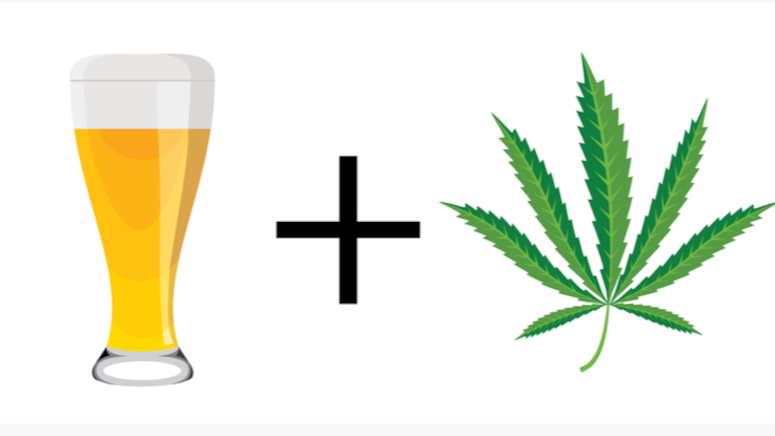

Alcohol use and marijuana use are each associated with significantly increased risks of fatal crash involvement. When alcohol and marijuana are used together there exists a positive synergistic effect on fatal crash risk on the additive scale.
Chihuri, Li and Chen, 2017, cited in Wigmore on Alcohol 2e, pg 382

The Study Design
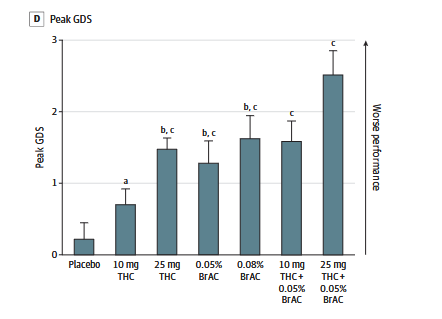 A new study of the effects of 10 or 25 mg cannabis brownies (18% THC) and a BAC of 50 mg/100mL on driving ability and the SFSTs were determined on 15 male and 10 female drivers with a mean age of 25.6 years. The drivers were also tested under placebo conditions and a BAC of 80 mg/100mL alone. This design allowed researchers to compare the impairment caused by alcohol and cannabis both separately and together.
Blood samples were collected and THC, 11-OH-THC, and THCCOOH concentrations were measured by LC-MS/MS. The mean peak blood THC was 3.5 ng/mL for the 25 mg THC edible. This is a relatively low blood THC concentration – well within the legal limits in most countries. Yet when combined with alcohol and cannabis, the impairment was significant.
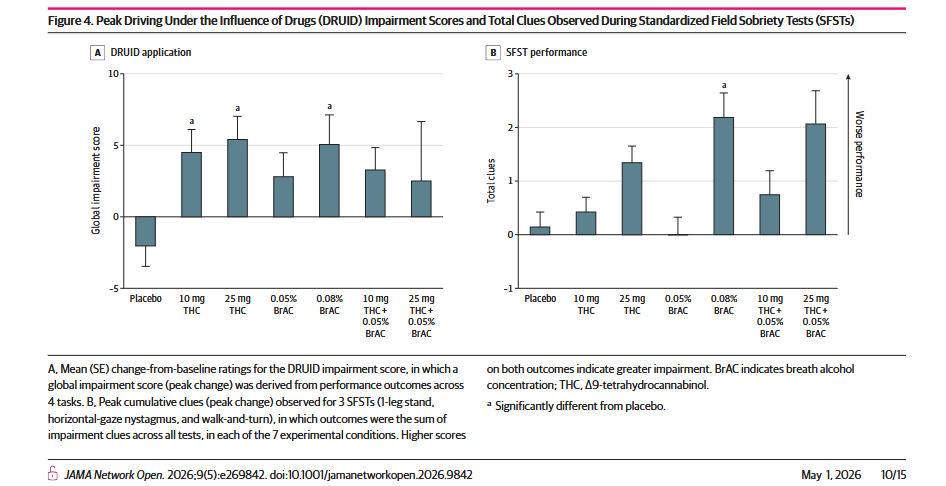
The drivers were tested on a STSIM Drive M4000 R driving simulator, and the impairment of driving ability was measured on a global drive score (GDS), where worsening driving performance was measured by an increase in the GDS. Both preliminary screening tests conducted by the police, especially the SFST, detected the 80 mg/100mL and the 25 mg THC and 50 mg/100mL conditions. This means that standard roadside tests can identify drivers impaired by the combination of alcohol and cannabis.
H2: 50 + 25 > 80
 The authors were concerned with the real-world applications of their study. Even though the driver may have impairment equal to or greater than at a BAC of 80 mg/100mL, the drug results would show 3.5 ng/mL THC and 50 mg/100mL BAC – both under the current THC/alcohol limits in most countries. In other words, a driver could be significantly impaired by the combination of alcohol and cannabis yet still be legally under the limit for each substance individually. This is a critical gap in public safety.
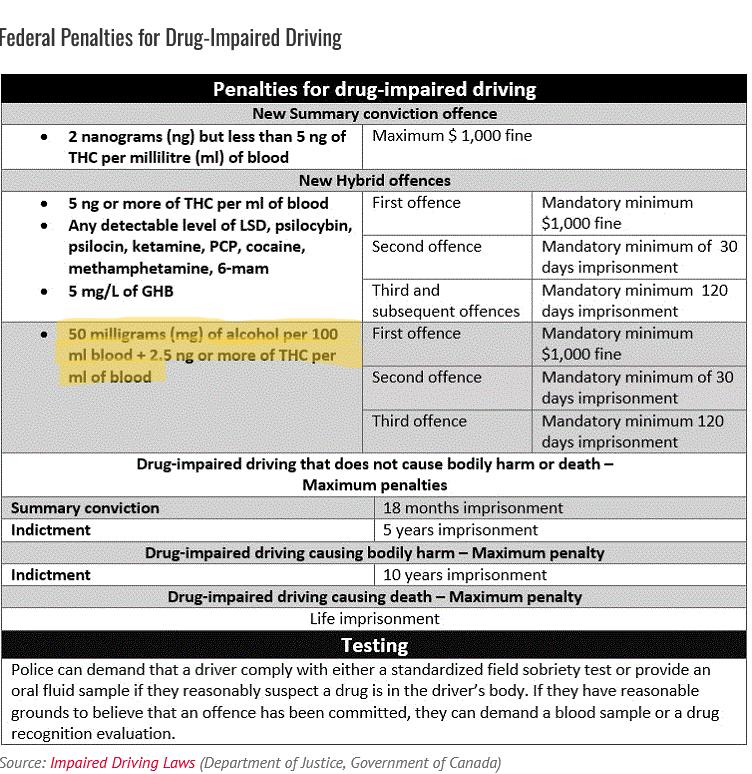
One solution to this problem was addressed in the Criminal Code of Canada in response to Canada’s legalization of cannabis in 2018. The offenses and penalties for drug-impaired driving include specific thresholds for alcohol and cannabis combined.
For drivers with 50 mg/100mL alcohol + 2.5 ng/mL THC or more:
- First offence: Mandatory minimum $1,000 fine
- Second offence: Mandatory minimum 30 days imprisonment
- Third offence: Mandatory minimum 120 days imprisonment
Since the blood THC limit is from 2 to 5 ng/mL for a lesser summary offense and greater penalties for blood THC of 5 ng/mL and greater, the drivers in this study would have been charged with the lesser offense as the mean peak blood THC concentrations were 3.5 ng/mL.
However, there is a greater offense if the blood THC concentration of the driver exceeded 2.5 ng/mL and the BAC was 50 mg/100mL or greater. Effectively, the BAC limit of 80 mg/100mL is lowered to 50 mg/100mL with the co-detection of blood THC concentration. The drivers would be charged with this greater offense after consuming 25 mg THC and a BAC of 50 mg/100mL – exactly the combination tested in the study.
This demonstrates that Canadian law has recognized the synergistic danger of alcohol and cannabis and has created specific penalties to address it. But many countries, including most US states, have not yet followed suit.
Conclusion
The authors of the study conclude:
“In this crossover trial of healthy adults who co-used cannabis and alcohol, cannabis edibles combined with alcohol augmented driving impairment. The legal intoxication limit in most of the US (0.08% BrAC) may be too liberal if a driver has co-used cannabis and alcohol. In this era of expanding cannabis legalization, there is a pressing public health need for improved impairment detection strategies and consideration of cannabis and alcohol co-use in policies dictating access to these substances.”
The evidence is clear: alcohol and cannabis together create a dangerous synergy that impairs driving far more than either substance alone. As cannabis legalization continues to expand across North America, policymakers must consider the combined effect of alcohol and cannabis when setting legal limits. The Canadian approach – lowering the effective BAC limit to 50 mg/100mL when THC is detected – provides a model for other jurisdictions to follow. Public safety demands nothing less.
References:
Contact a Forensic Expert Who Understands Alcohol and Cannabis Synergy
Consult Canada's Leading Forensic Toxicologist
James Wigmore has testified in over 700 criminal cases involving alcohol and cannabis impairment, back-calculation, and impaired driving defence. With 50 years of experience at the Centre of Forensic Sciences in Toronto and authorship of Wigmore on Alcohol and Wigmore on Cannabis, he provides expert insight into the science of combined substance impairment for legal professionals.
Contact James Wigmore TodayPut 50 years of forensic expertise on your side. Reach out now for expert consultation.
FAQs on Alcohol and Cannabis and Driving
What does the title "1+1=3" mean in this context?
It means the combined effect of alcohol and cannabis on driving impairment is greater than the sum of their individual effects – a synergistic interaction.
What were the key findings of the 2026 study?
Combining 25 mg THC (edible) with a BAC of 50 mg/100mL produced impairment greater than a BAC of 80 mg/100mL alone.
What was the mean peak blood THC concentration in the study?
The mean peak blood THC was 3.5 ng/mL for the 25 mg THC edible – below the 5 ng/mL limit for serious criminal charges in Canada.
How does Canadian law address combined alcohol and cannabis impairment?
Canada has a specific offense if blood THC exceeds 2.5 ng/mL and BAC is 50 mg/100mL or greater, effectively lowering the BAC limit to 50 mg/100mL when THC is detected.
What are the penalties for the combined alcohol and cannabis offense in Canada?
First offence: $1,000 mandatory minimum fine. Second offence: 30 days mandatory minimum imprisonment. Third offence: 120 days mandatory minimum imprisonment.
What driving simulator was used in the study?
The STSIM Drive M4000 R driving simulator was used to measure impairment.
How many participants were in the study?
25 drivers – 15 male and 10 female – with a mean age of 25.6 years.
What was the THC content of the cannabis brownies used?
The brownies contained 18% THC, in doses of 10 mg or 25 mg.
Did police roadside tests detect the impairment?
Yes, both standardized field sobriety tests (SFSTs) and the DRUID impairment scores detected the 80 mg/100mL alcohol and the 25 mg THC + 50 mg/100mL alcohol conditions.
What is the authors' recommendation for US legal limits?
The authors suggest that the US legal limit of 0.08% BrAC may be too liberal if a driver has also used cannabis.
Recent News
Cannabis and Alcohol and Driving: 1+1 =3?
When it comes to driving impairment, the combination of alcohol and cannabis is far more dangerous than...
Read More
A Tragic Cannabis-Related Fatal Motor Vehicle Coll...
A sunny June afternoon. A minivan stopped at a red light. Inside: a mother and...
Read More
Cannabis, Alcohol and Suicide
Does daily cannabis use put your mental health at risk? New forensic research reveals a...
Read More
The Myth of “Next Day” Effects After S...
The debate about impairment after smoking cannabis often extends into the next day. A rigorous...
Read More