


Cannabis, Alcohol and Suicide
Does daily cannabis use put your mental health at risk? New forensic research reveals a shocking link between THC, suicide, and soaring rates of anxiety and depression.
The Hidden Risks of Anxiety and Depression from Cannabis
A comparison was conducted of cannabis, alcohol and drug use in 12,750 persons (ages 16 years +) who died of suicide and 43,465 case control cases in 2013 in the US. This large-scale study provides critical insights into how substances affect suicidal behaviour, as well as their links to anxiety and depression.
Positive postmortem blood THC results were detected in 17.1% of the suicide victims and 7.2% of the control cases. This means suicide victims were more than twice as likely to have THC in their system compared to the control group. However, postmortem blood alcohol concentrations were found in 39.5% of the suicide victims compared to 2.4% of the controls. The adjusted odds ratio of suicide were:
THC – 1.83X
Alcohol – 20.53X
These numbers show that while cannabis does increase suicide risk, alcohol remains a far more significant factor. However, this study may underestimate the current risk of suicide with cannabis use as it was based on 2013 data, before widespread legalization and the large increase in THC potency of cannabis products. Today’s cannabis is much stronger than what was available in 2013, which may worsen anxiety and depression in vulnerable users.

WARNING: Using cannabis every day or most days can lead to dependence. Dependence also increases your risk of anxiety and depression.
Health Canada

Jump From a Height:
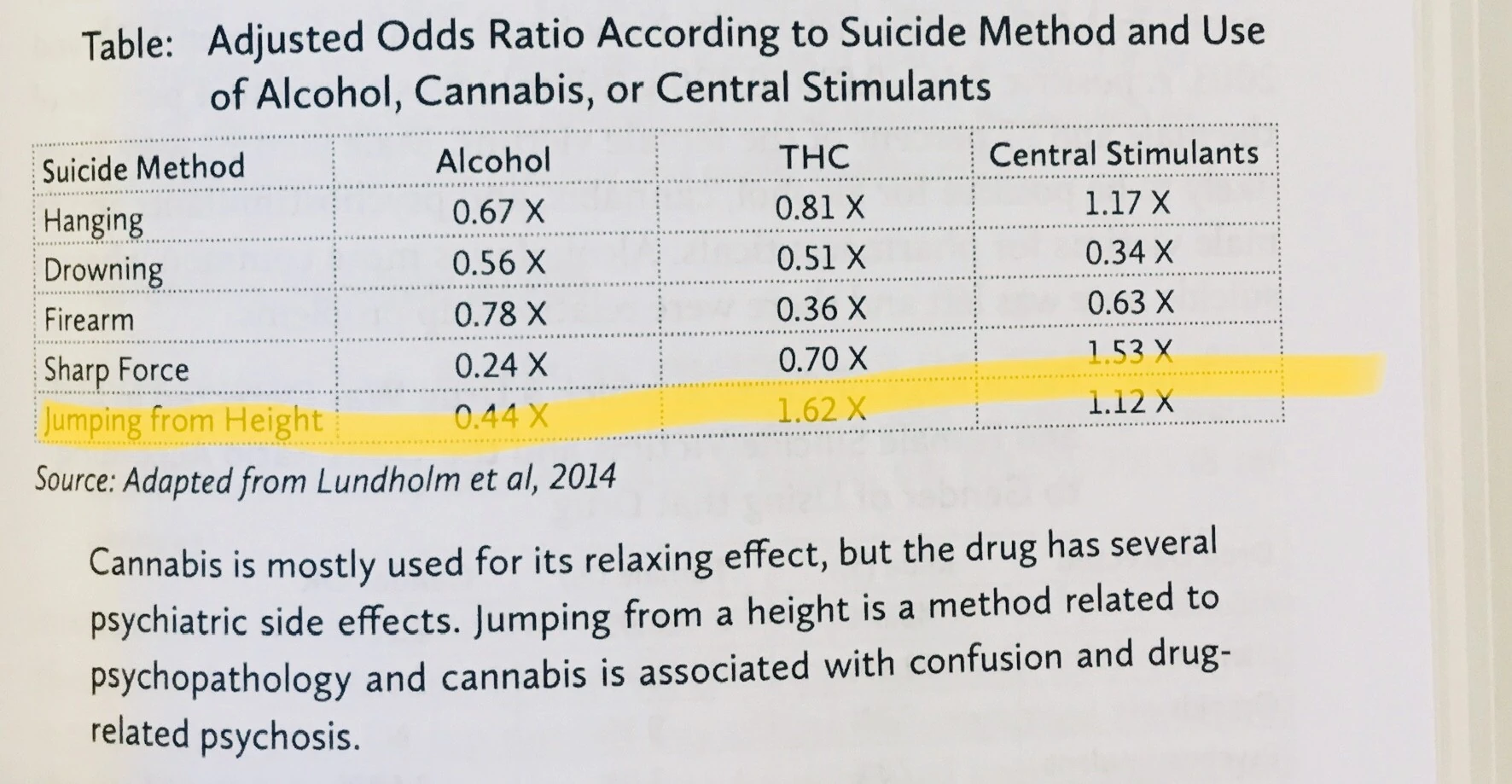 Although the previous study did not determine the mode of suicide, another study using 21,894 suicide victims who died in Sweden between 1994 and 2009 showed an increased adjusted odds ratio of suicide victims who jump from heights on THC. This Swedish research broke down suicide methods to identify which ones are most strongly linked to specific substances.
Cannabis is mostly used for its relaxing effect, but the drug has several psychiatric side effects, including worsening anxiety and depression. Jumping from a height is a method related to psychopathology and cannabis is associated with confusion and drug-related psychosis. A case report also showed suicide ideation with cannabis use for jumping from a height. The data reveals that for jumping from a height, THC had an adjusted odds ratio of 1.62X, which is significantly higher than alcohol at 0.44X for the same method.
For other methods such as hanging, drowning, firearm, and sharp force, THC showed reduced odds ratios ranging from 0.36X to 0.8X. This suggests that THC does not increase risk for all suicide methods equally. Instead, it appears to be uniquely dangerous for impulsive, high-risk behaviours like jumping from a height, especially in individuals already struggling with anxiety and depression.
Case Report: Suicidal Ideation Induced by Cannabis
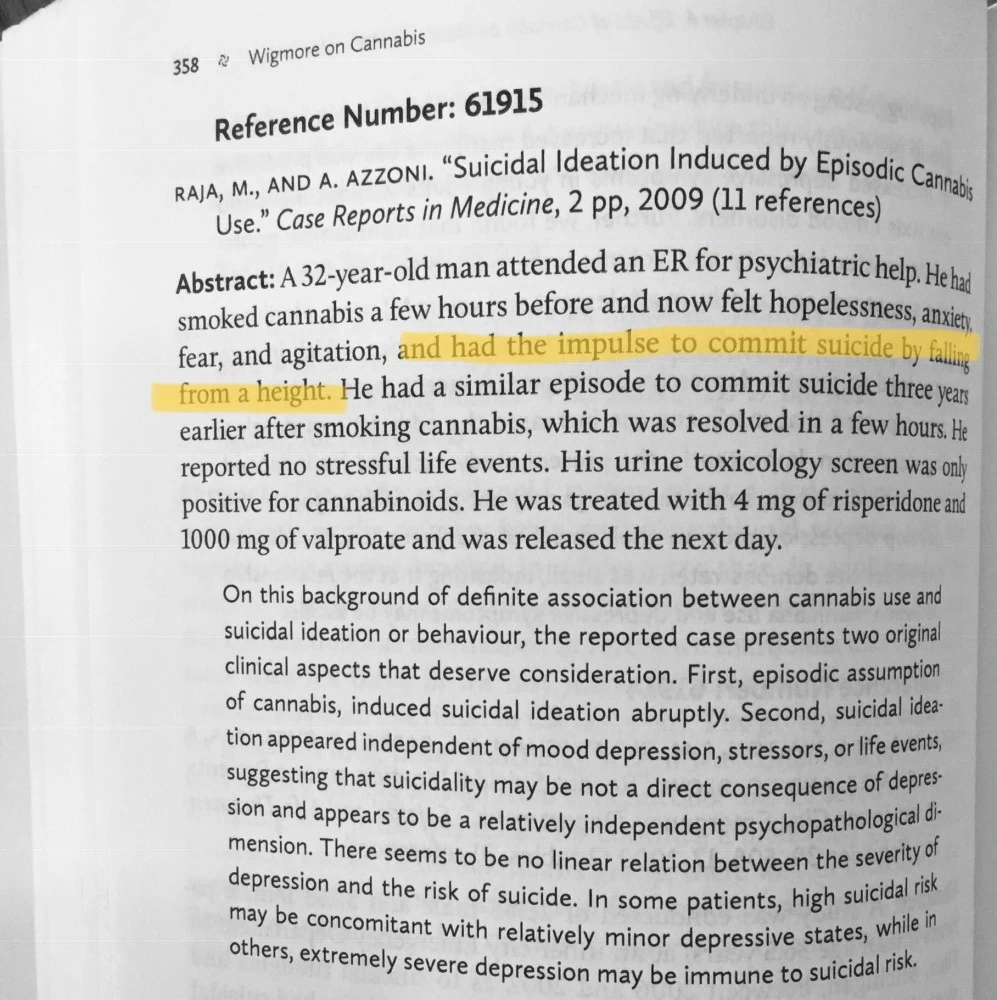 A 32-year-old man attended an ER for psychiatric help. He had smoked cannabis a few hours before and now felt hopelessness, anxiety, fear, and agitation, and had the impulse to commit suicide by falling from a height. He had a similar episode three years earlier after smoking cannabis, which resolved in a few hours. He reported no stressful life events. His urine toxicology screen was only positive for cannabinoids. He was treated with 4mg of risperidone and 1000mg of valproate and was released the next day.
This case presents two original clinical aspects:
- Episodic cannabis use induced suicidal ideation abruptly
- Suicidal ideation appeared independent of mood depression, stressors, or life events
There seems to be no linear relation between the severity of anxiety and depression and the risk of suicide. In some patients, high suicidal risk may be concomitant with relatively minor depressive states, while in others, extremely severe depression may be immune to suicidal risk.
Conclusions
Shi and Li (2025) concluded that:
“Cannabis use is a significant risk factor for suicide, independent of alcohol use and demographic characteristics. Policy makers should take into consideration the excess risk of suicide associated with cannabis use when assessing the externalities of legalizing cannabis.”
References:
Lundholm, L.., Thiblin, I., Runeson, B., et al., “Acute Influence of Alcohol, THC or Central Stimulants on Violent Suicide: A Swedish Population Study”, Journal of Forensic Sciences, 59: 436-440, 2014
Shi, Q., and Li, G., “Cannabis Use and Suicide: A Case-Control Study Based on Integrative Data Analysis” Journal of Cannabis Research, 7: 93, 2025
Act Now: Understand the Hidden Risks of Cannabis
Leverage Forensic Science to Assess Suicide and Mental Health Risks
James Wigmore’s forensic team continuously reviews and catalogs over 14,000 studies – giving you access to cutting-edge insights that can expose the links between cannabis use, anxiety and depression, and suicidal behaviour.
Get a Free Forensic Consultation!Don’t let misleading claims about cannabis safety shape policy or clinical decisions. Contact us today.
FAQs on Anxiety and Depression from Cannabis and Alcohol
Does daily cannabis use directly cause anxiety and depression?
Health Canada warns that dependence from daily use increases your risk of anxiety and depression.
How much does cannabis use increase suicide risk according to the 2013 US study?
Cannabis can cause confusion, psychosis, and impulsive behaviour – all linked to this method.
Can one episode of cannabis use cause suicidal thoughts?
Yes, the Raja & Azzoni case report shows a man developed sudden suicidal ideation within hours.
What percentage of suicide victims tested positive for THC in the 2013 US study?
Positive postmortem blood THC results were detected in 17.1% of suicide victims compared to 7.2% of control cases.
Why might the 2013 study underestimate current suicide risk from cannabis?
The study was conducted before widespread legalization and the large increase in THC potency of cannabis products.
What treatment did the 32-year-old patient receive after cannabis-induced suicidal ideation?
He was treated with 4mg of risperidone and 1000mg of valproate and was released the next day.
According to Lundholm et al. 2014, which suicide method had the highest adjusted odds ratio for THC?
Jumping from a height had the highest at 1.62X, followed by hanging at 0.8X and sharp force at 0.7X.
Recent News

Cannabis, Alcohol and Suicide
Does daily cannabis use put your mental health at risk? New forensic research reveals a...
Read More
The Myth of “Next Day” Effects After S...
The debate about impairment after smoking cannabis often extends into the next day. A rigorous...
Read More
Does Workplace Cannabis Use Increase the Risk of I...
A critical new study provides essential data on cannabis use and workplace safety, revealing a clear distinction...
Read More
Oral Fluid Screening and Blood Tests for THC in Su...
The legalization of cannabis in Canada in 2018 created an urgent need for reliable, roadside...
Read More