


H. Ward Smith Award
A cross-Canada road trip. A coffee-stained award copy. A Nobel Prize complaint from a fellow scientist. And a piece of research that won international recognition. This is the story behind my H. Ward Smith Award.

Now I hope you will start doing some bloody work.
A.E.D. Hall, Assistant Toxicology Section Head, Centre of Forensic Sciences, 1987

The Research Behind the Award
“Now I hope you will start doing some bloody work.” – A.E.D. Hall, Assistant Toxicology Section Head, Centre of Forensic Sciences, 1987
That tends to be the comment of a lot of management in forensic laboratories. Research is considered a bit of a waste of time and interferes with the quest of reducing the turnaround time of cases. A.E.D. Hall was half joking, as I did this research with my colleague Dr. Michael Ward and summer student Patrick McMenamin in my spare time.
The research, which was to determine the 3 ketone bodies in the blood of sexual assault victims, won an outstanding research contribution which paid for travel and expenses to the International Association of Forensic Science meeting in Vancouver in August 1987. That research would eventually lead to the H. Ward Smith Award.
What Is the H. Ward Smith Award?
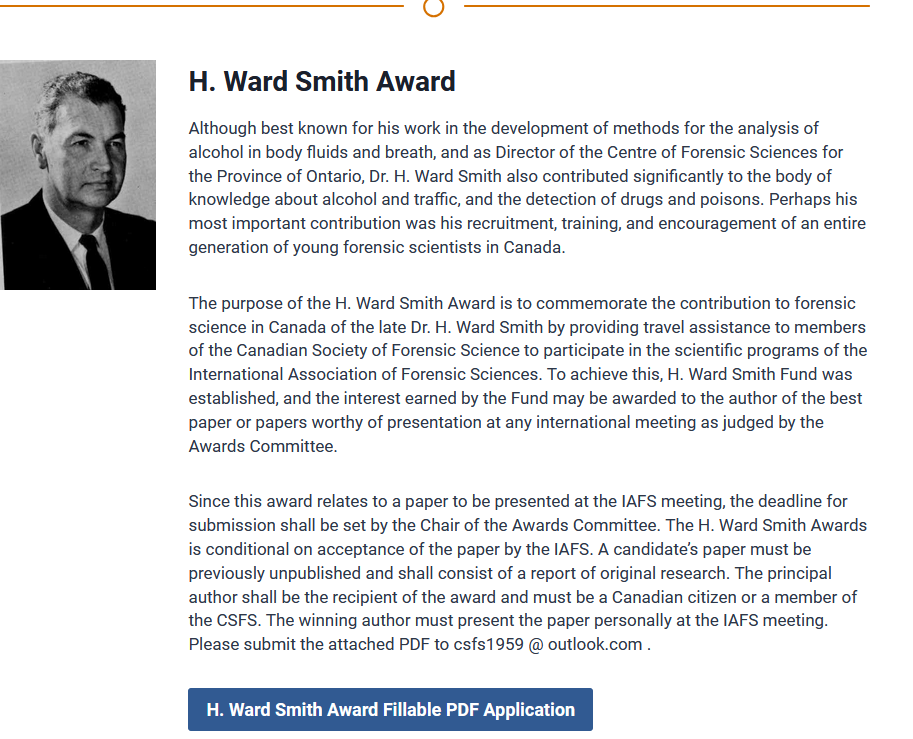 Although best known for his work in the development of methods for the analysis of alcohol in body fluids and breath, and as Director of the Centre of Forensic Sciences for the Province of Ontario, Dr. H. Ward Smith also contributed significantly to the body of knowledge about alcohol and traffic, and the detection of drugs and poisons. Perhaps his most important contribution was his recruitment, training, and encouragement of an entire generation of young forensic scientists in Canada.
The purpose of the H. Ward Smith Award is to commemorate the contribution to forensic science in Canada of the late Dr. H. Ward Smith by providing travel assistance to members of the Canadian Society of Forensic Science to participate in the scientific programs of the International Association of Forensic Sciences.
Since this award relates to a paper to be presented at the IAFS meeting, the deadline for submission is set by the Chair of the Awards Committee. The H. Ward Smith Award is conditional on acceptance of the paper by the IAFS. A candidate’s paper must be previously unpublished and consist of a report of original research. The principal author shall be the recipient of the award and must be a Canadian citizen or a member of the CSFS. The winning author must present the paper personally at the IAFS meeting.
9,108 Kilometre Road Trip
As Mike Ward was presenting our paper at the IAFS meeting in Vancouver, he flew. I had never done the unique Canadian experience of travelling across Canada in a car in a short period of time. And so on July 24th, 1987, I left Toronto with my high school chum, Brian Gallaugher, in a Subaru GL 1985 on the great cross-Canada Vancouver trip.
Surprisingly, the hardest drive of the trip was not through the Rockies but through the rock cuts, swamps and bush of Northern Ontario. The highway was narrow, the wildlife was abundant, and the mosquitos were relentless. But we pushed through.
We arrived in Vancouver on August 2, 1987, in time for the IAFS meeting. There were over 1,200 delegates from over 50 countries represented. We left Vancouver on August 9, 1987, after the meeting was over, and arrived back in Toronto on August 15, 1987, for a total car trip of 9,108 kilometres (5,465 miles).
IAFS Vancouver and Kurt Dubowski
Our paper was presented at a session chaired by Dr. Kurt Dubowski, who I had met on the Borkenstein course at Indiana University in 1986, so I was aware of his ego. But he was very gracious and charming during the session. His ego only appeared when he complained to me that he was sorry that he would not get a Nobel Prize, because the average Nobel Prize Award winner published on average over 200 papers and he had only published 120.
That moment stuck with me. Here was a distinguished scientist, at the top of his field, still measuring himself against an impossible standard. It reminded me that recognition like the H. Ward Smith Award is meaningful, but it is not the end goal. The work itself matters most.
H. Ward Smith Award Presentation
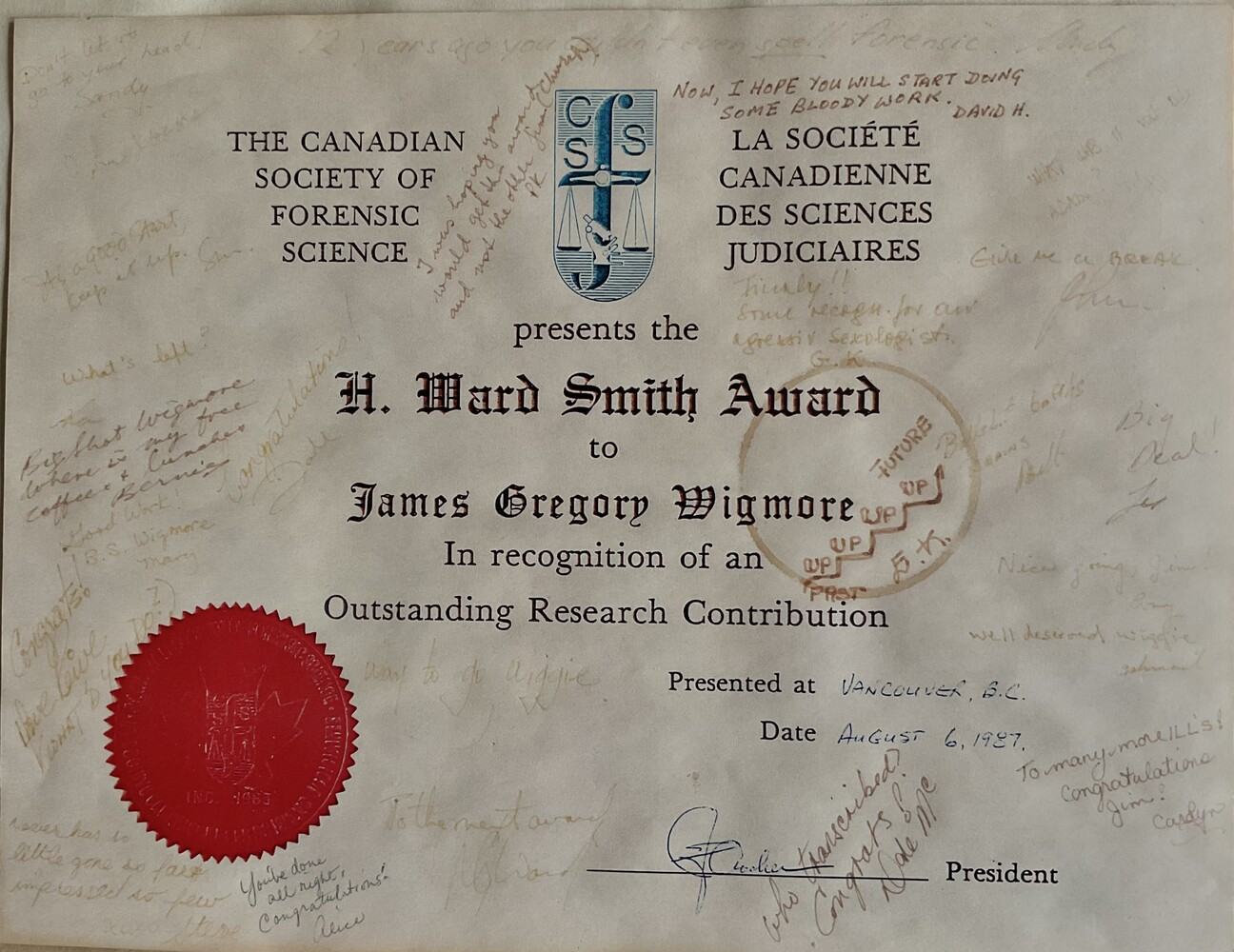
The CFS toxicology section had a bit of a social gathering welcoming me back from Vancouver and presenting me with the H. Ward Smith Award, which they held in safe keeping while I was travelling.
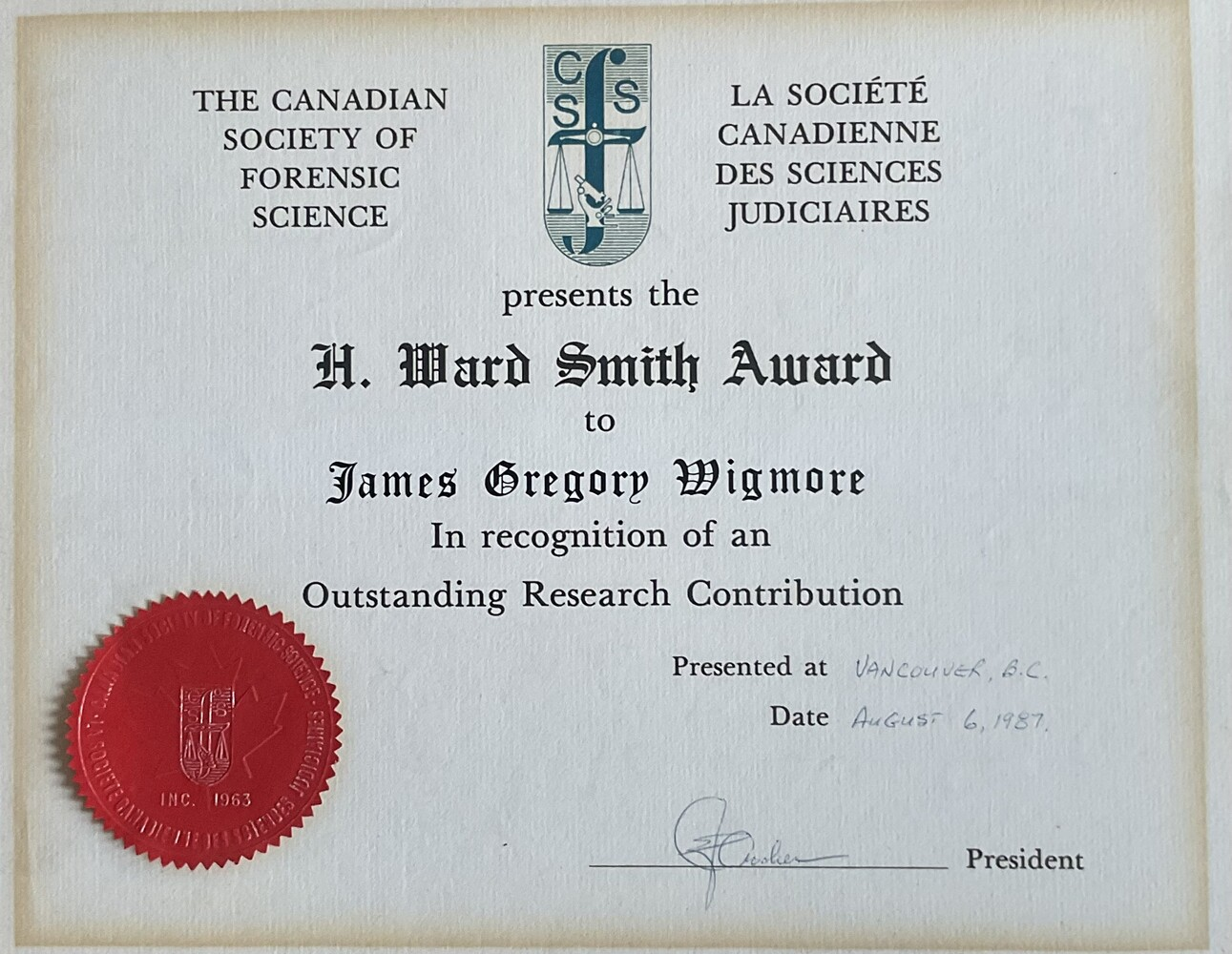
I must say I was a bit shocked as the award looked like it was written all over and had a coffee stain on it. I thought, “Is this really the award I waited for?” But I soon realized they had made a colour copy (unusual for that time) of the original and wrote on the copy as a joke.
The original was safe.
Past Winners
1972 – Sivarama S. Krishnan
1975 – John Wells (1st prize), William Sturner (2nd prize)
1981 – Pamela Newall
1984 – Hiron Poon
1987 – M.J. Ward and co-authors, J.G. Wigmore and P.H. McMenamin
1990 – Wayne Hindmarsh
1999 – Kathy Gruspier
2017 – Caroline Mireault
2023 – Rolanda Lam
Winning the H. Ward Smith Award in 1987 was a highlight of my early career. It validated that research done in spare time, despite management skepticism, could lead to international recognition. And the 9,108 kilometre road trip across Canada remains one of my fondest memories.
References
- Ward, M.J., Wigmore, J.G., and McMenamin, P.J., “A Headspace gas Chromatographic Method for the Determination of Total Ketone Body Concentration in Blood: Analysis of Samples Collected from Victims of Sexual Assault”, Canadian Society of Forensic Science Journal, 20: 107-117, 1987
- Wigmore, J.G., and Ward, M.J., “The Incidence of Ethanol and Acetone in the Blood and Urine of Victims of Sexual Assault.”, Canadian Society of Forensic Science Journal, 19: 49-58, 1986
Contact an H. Ward Smith Award Winner
Consult Canada's Most Decorated Forensic Toxicologist
James Wigmore received the H. Ward Smith Award in 1987, the Director’s Award in 1989, and the Derome Award in 2005 – three of the highest honours in Canadian forensic science. With over 29 years at Toronto’s Centre of Forensic Sciences, more than 700 criminal cases, and 70+ peer-reviewed publications, he provides unparalleled expertise in forensic toxicology, alcohol analysis, and courtroom testimony.
Contact James Wigmore TodayPut an H. Ward Smith Award winner on your side. Reach out now for expert consultation.
FAQs on the H. Ward Smith Award
What is the H. Ward Smith Award?
It is an award that provides travel assistance to Canadian forensic scientists to present original research at International Association of Forensic Sciences meetings.
Who was Dr. H. Ward Smith?
He was the Director of the Centre of Forensic Sciences for Ontario and a pioneer in alcohol analysis in body fluids and breath.
What research won James Wigmore the H. Ward Smith Award in 1987?
Research on the determination of 3 ketone bodies in the blood of sexual assault victims, conducted with Dr. Michael Ward and Patrick McMenamin.
How far did Wigmore drive to attend the IAFS meeting in Vancouver?
He drove 9,108 kilometres (5,465 miles) from Toronto to Vancouver and back in a 1985 Subaru GL.
Who joined Wigmore on the cross-Canada road trip?
His high school friend, Brian Gallaugher.
When did Wigmore leave Toronto for Vancouver?
On July 24th, 1987.
When did he return to Toronto?
On August 15th, 1987.
What was the hardest part of the drive?
Surprisingly, not the Rockies but the rock cuts, swamps and bush of Northern Ontario.
Who chaired the session where Wigmore's paper was presented?
Dr. Kurt Dubowski, whom Wigmore had met on the Borkenstein course in 1986.
What did Dubowski complain about regarding the Nobel Prize?
He said he was sorry he would not get a Nobel Prize because he had only published 120 papers, while the average Nobel winner publishes over 200.
Recent News
Earthquake!
Listen, Understand, Consider, Answer, Shut-up. The Doug Lucas approach to answering questions in court. When...
Read More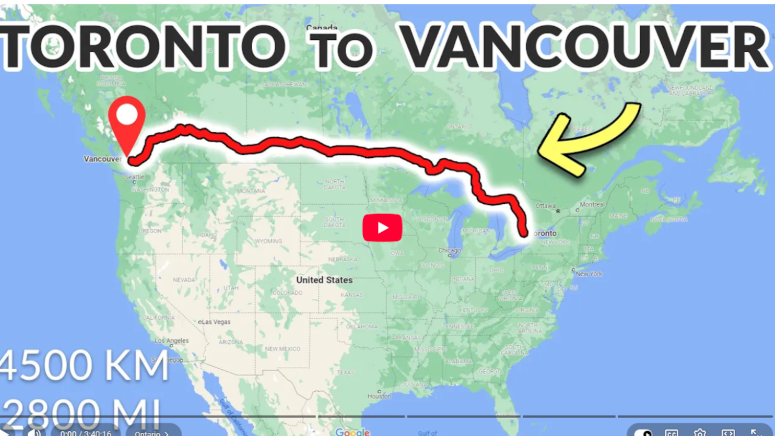
H. Ward Smith Award
A cross-Canada road trip. A coffee-stained award copy. A Nobel Prize complaint from a fellow...
Read More
Director’s Award
No red carpet. No Academy. Just 100 colleagues at the Centre of Forensic Sciences in...
Read More
Derome Award, Prix du Merite
Only ten forensic scientists have received this honour in 25 years. Four received it posthumously....
Read More