


The Making of Wigmore on Alcohol: A Journey for Over 50 Years
I joined the Centre of Forensic Sciences in Toronto on February 16th, 1976, as a junior technician and repaired all the Breathalyzers (Models 800, 900, and 900A) used for alcohol testing by the police forces in the Province of Ontario. I was fortunate to have excellent and very dedicated managers at the time: Doug Lucas was the Director, George Cimbura was the Head of the Toxicology Section, and Ron Hallett was in charge of the breath testing program. What began as a job repairing instruments became a lifelong career in forensic alcohol toxicology, eventually producing the definitive textbook, Wigmore on Alcohol.
Electric Typewriters!
I became fascinated by the various aspects of forensic alcohol toxicology and especially the interaction of the scientists, police, crown attorneys, defence lawyers, judges, and the general public. I eventually went back to the University of Toronto in my own time and finished my four-year BSc. I taught the Breathalyzer course for the police technicians and later became a scientist. After my extensive training I was qualified to testify in court.
Early on I collected studies on the various areas of forensic alcohol toxicology, especially in breath alcohol and alcohol testing research. I concentrated on human studies alone, and did not include any animal studies as I feel they are not proper for criminal court.
These studies were valuable for my education and to form the basis and support for my scientific opinion in court. Initially, I read the study and highlighted in yellow the particular passages of the study and had them in three-ring binders according to subject. I then got the Toxicology secretaries (mainly Gladys Uchimaru) to type our file cards with the name of the authors, title and citation. Interestingly at that time, there were only two electric typewriters in the entire Toxicology Section (and of course no computers). The scientists wrote out their reports in hand and the two secretaries typed them out, with one copy on “onion skin” paper.
File Express
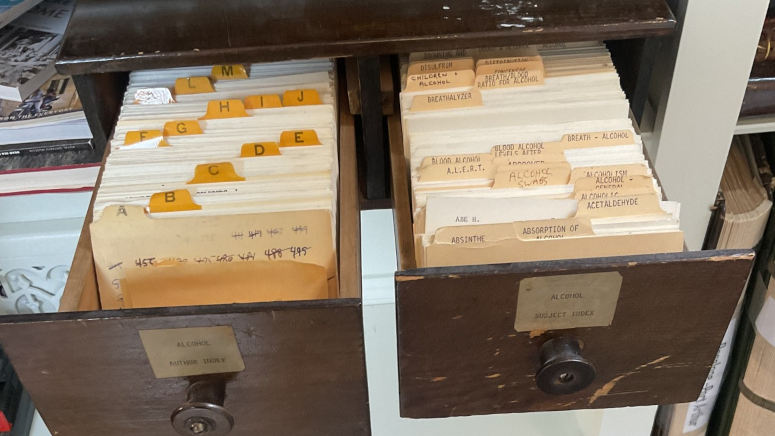
The typed file cards were placed in two wooden file holders (which I still have), and placed alphabetically according to author and one on subject. After about one thousand papers, including alcohol testing results and alcohol testing related studies, this system got too cumbersome. Also, in the mid-1980s computers started appearing in the lab.
My first computer was a 286 and included a program called “File Express”, which were like electronic file cards but could be searched field by field. I soon developed my current technique of an alcohol database. I would read the study and make notes about how the study was conducted and how the alcohol testing was performed. I also copied a short passage from the study that summarized the conclusions or results in the author’s own words. This I then typed into File Express. This was much better than just highlighting a paper and also could be searched, although the search took a long time.
After entering about 3,500 studies, a search on a certain topic would take several hours, sometimes overnight.
As computers got faster and more sophisticated a new program was developed called Endnotes. It was much superior to File Express. One of my colleagues was able to transfer all the data from File Express into Endnotes and continued with my updates to the database until I retired.
Toxic Volume of the Lungs
One area of forensic alcohol toxicology I was weak in was the studies published in German. After English, German was the second language of forensic alcohol toxicology. E.M.P. Widmark wrote in German as well as many other scientists. So I enrolled in several night courses offered at the University of Toronto in reading scientific German and so translated the German studies of merit. I was also fortunate to obtain many translations conducted for the RCMP.
The slight problem with the RCMP translations was that they were made by non-scientific translators and so sometimes the translation would be stilted. I remember one translation of a German paper referred to the “toxic spaces of the lungs” over and over again. It was not until I referred to the original German that I realized it was “dead space of the lungs” not the “toxic volume of the lungs”. This is why accurate alcohol testing research requires going back to primary sources.
First Book
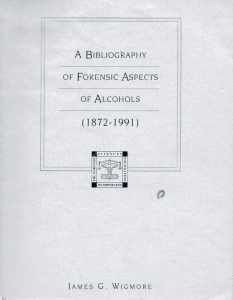 In 1991, I put together a printed bibliography consisting of 2,300 studies on various aspects of forensic alcohol science, including alcohol testing research, with the encouragement of Doug Lucas.
It was published by the Forensic Sciences Foundation, a non-profit organization associated with the American Academy of Forensic Science. It was rather unsophisticated, using a dot-matrix printer, bound in a plastic spiral with 539 pages. There were only five major sections, citations by author, alcohol and driving, breath alcohol, blood alcohol and pharmacokinetics of alcohol. There were no annotations or indices. Robert H. Cravey, the chief toxicologist of Orange County California kindly wrote a Foreword.
The book was published in 1992 and was called “A Bibliography of Forensic Aspects of Alcohols (1872-1991).” I don’t know how many copies were sold, but probably not a lot.
However, the book is listed on WorldCat.org, the world’s largest library with over 1.5 billion items in its catalog. Five libraries are listed as holding copies and are:
- Bibliothèque psychiatrique universitaire de Lausanne, Switzerland
- University of Groningen Library, Netherlands
- John Jay College of Criminal Justice Library, New York
- Federal Bureau of Investigation Academic Library, Quantico
- Ohio State University Libraries, Columbus
Court, Court, Court and More Court!
Meanwhile, I was thrown across the whole province to testify in criminal court, mainly drinking and driving alcohol testing cases, but also other criminal matters such as sexual assaults or homicides. For weeks at a time I would be on the road and not attend the Centre of Forensic Sciences. So I developed the practice of while waiting outside of court to testify I would read and abstract alcohol papers and write them by hand on paper. When I returned home I would then type the notes up on File Express and then download the file into the lab computers.
I was able to obtain the papers by ordering about 30 studies every month from the H. Ward Smith Library at the Centre of Forensic Sciences and all the time waiting in the court hallways allowed me to read them.
Intoxilyzer 5000C Comes to Canada
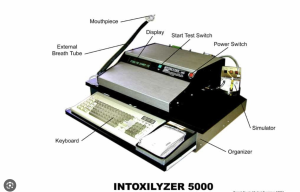 The manual Breathalyzer had been used for alcohol testing by the police in Ontario since 1956. In the early 1990s the director of the Centre of Forensic Sciences, Doug Lucas and the head of the Breathalyzer program in Ontario, Ron Hallett assigned me the task of introducing the more modern, automatic Intoxilyzer 5000C to Ontario. It was quite a challenge but fortunately I had the assistance of Jeff Patrick of the Toronto Police Services (a technical wiz!) among others which helped immensely.
Jeff and I went for training at CMI Inc in Owensboro, Kentucky (the manufacturer) and at the Bureau of Criminal Apprehension in Minnesota which had run the Intoxilyzer 5000 program in that state for many years. We eventually developed the standards and training programs and conducted our first alcohol testing courses at the CFS for Intoxilyzer 5000C technicians.
In early 1994, the first Intoxilyzer alcohol testing was conducted in Toronto on arrested drinking drivers. Since then, the program expanded greatly and by the time of my retirement in 2005, over 95% of breath tests conducted in Ontario were done by the Intoxilyzer 5000C, and within five years of my retirement, no Breathalyzer tests were conducted at all. Eventually the Intoxilyzer 5000C is being replaced by the Intoxilyzer 8000C.
Court Notes on Alcohol
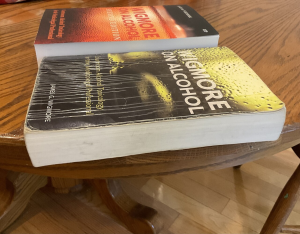 After years of alcohol testing and courtroom experience, in 2001 I wrote a 25-page booklet entitled “Court Notes on Alcohol,” which was a precursor to my much expanded and more detailed Wigmore on Alcohol: Courtroom Alcohol Toxicology for the Medicolegal Professional. The booklet was an improvement on my Bibliography as it had my notes for each paper and was organized into 20 sections.
I found it useful to have in my briefcase when I went to court and referred to it numerous times before testifying. Other court-going forensic toxicologists at the CFS also took it to court. The booklet was a bit like an acorn from which my opus magnus – Wigmore on Alcohol – sprouted.
Eye-Opener
I developed an alcohol-discussion group in 2003 to assist in the training of a lot of new toxicologists hired by the CFS and to keep the experienced ones up to date. It was held at morning coffee and since we discussed alcohol testing, it was called “The Eye-Opener,” which is “an alcoholic drink taken early in the morning.” It was held approximately every month, and I gave all the toxicologists the various papers to be discussed and assigned each scientist which paper to present. Several scientists did PowerPoint presentations. It was a popular session, mainly I think because I provided the donuts!
"Retirement"
I retired from the Centre of Forensic Sciences in May 2005, using the Factor 80 provisions that were temporarily introduced. My colleagues presented me with a hardcover bound copy of all the scientific papers (63) that I had published thus far. The book was entitled “Musings of James G. Wigmore (1984-2005).” About 20 copies were privately printed.
My very first day of retirement was unlike any that I would have imagined. I had to testify in front of a jury at a superior court on a case of “impaired causing death.” The case involved an off-duty police officer who drank excessively at a bar and drove head-on into another car, killing one person and injuring another. I had analysed the blood for alcohol testing when I was at the CFS before retirement and my results agreed well with the hospital results of the accused. The jury eventually convicted the accused.
During my initial retirement I testified in four jury trials of “impaired causing death” in front of a jury in which all resulted in a finding of guilt. I was also very busy in Brampton and Peterborough courts testifying in “over 80” cases, but after 5 years I stopped doing criminal cases in Ontario. For another year I testified in criminal trials in BC and Alberta, but eventually stopped all criminal cases, and instead concentrated on writing my book – Wigmore on Alcohol – and writing alcohol testing reports for civil cases.
Wigmore on Alcohol
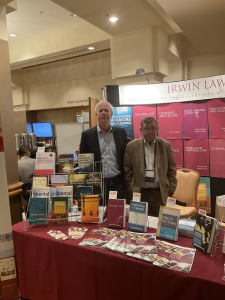 For approximately the next eight months for six hours a day, every day, I went through all my alcohol references on my database, choosing the most relevant alcohol testing studies that reflected scientific consensus on various forensic topics. I had several rough copies printed off and sent the copies to four different medicolegal publishers which all wanted to print the book.
The best offer was from Irwin Law, a publisher in Toronto and in March 2011, I signed the Author’s Publication Agreement. For the next six months the final design and editing of the book took place. I received usually weekly Author’s Queries (AQ) from the editors at Irwin Law during the editing process. My former director, Doug Lucas provided a great Foreword for the book. Irwin Law did a terrific job in the publication which occurred in November 2011.
Although I no longer testify in criminal court I am still actively involved in my alcohol testing database, teaching on the Borkenstein course at Indiana University, answering questions via email and LinkedIn of Borkenstein Alumni, and writing articles. I read and review about 300 scientific articles on forensic alcohol toxicology a year which are added to the database. I still enjoy the fascinating field of forensic alcohol toxicology and alcohol testing and in a few years, perhaps an updated second edition of the book will be published.
NOTE: The second edition of Wigmore on Alcohol was published in September 2024. An earlier version of this article was written in 2011, after the first edition of Wigmore on Alcohol was published.
Contact an Expert in Alcohol Testing
Consult Canada's Leading Forensic Toxicologist
James Wigmore spent 50 years in alcohol testing and forensic alcohol toxicology, testifying in over 700 criminal cases and authoring the definitive textbook Wigmore on Alcohol, now in its second edition. He provides expert insight for legal professionals.
Contact James Wigmore TodayPut 50 years of forensic expertise on your side. Reach out now for expert consultation.
FAQs on Alcohol Testing and Wigmore on Alcohol
When did James Wigmore join the Centre of Forensic Sciences?
On February 16th, 1976, as a junior technician repairing Breathalyzers used for alcohol testing.
What was the first book James Wigmore published?
"A Bibliography of Forensic Aspects of Alcohols (1872-1991)," published in 1992.
How many alcohol testing studies were in the first bibliography?
2,300 studies.
What computer program did Wigmore first use for his database?
File Express, on a 286 computer.
Why did Wigmore learn scientific German?
To translate German studies on forensic alcohol toxicology, including work by E.M.P. Widmark.
What was "Court Notes on Alcohol"?
A 25-page booklet written in 2001, a precursor to Wigmore on Alcohol.
When was the first edition of Wigmore on Alcohol published?
In November 2011, by Irwin Law.
When was the second edition published?
In September 2024.
What is the Intoxilyzer 5000C?
An automated breath alcohol testing instrument introduced to Ontario in 1994, replacing the manual Breathalyzer.
How many scientific papers had Wigmore published by his retirement?
63 papers, bound in a book titled "Musings of James G. Wigmore (1984-2005)."
Recent News
The Making of Wigmore on Alcohol: A Journey for Ov...
I joined the Centre of Forensic Sciences in Toronto on February 16th, 1976, as a...
Read More
Melbye and Me
The field of forensic anthropology in Canada owes much to one man: Dr. Melbye. He...
Read More
Niagara Falls, I Thought It Would be Bigger!
Some professional relationships transcend borders and decades. As a forensic toxicologist, I have been fortunate...
Read More
What is Project 50?
For 50 years, I have worked in the fascinating and challenging field of forensic toxicology....
Read More