


50 over 50
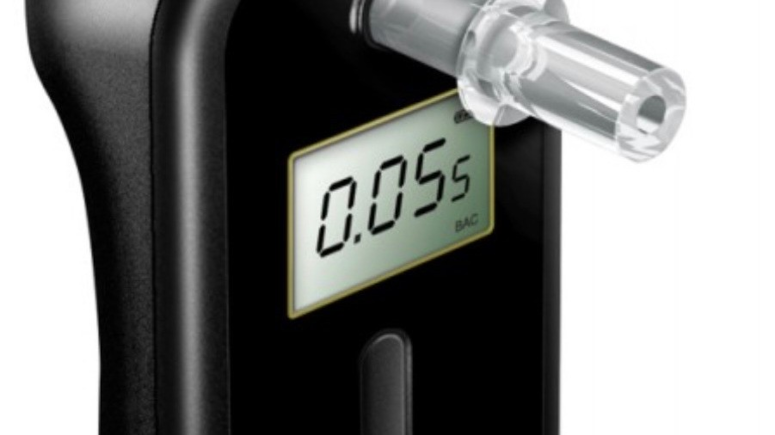
A common misconception is that unless the BAC of the driver is over 80 mg/100mL, the driver is not impaired by alcohol. Of course this is not true, as numerous laboratory, closed-course, highway and epidemiological studies — as shown in Chapter 5 of WOA 2e — establish that at BACs of 50 mg/100mL and over, all drivers are impaired in their driving ability. The legal driving BAC limit may be 80, but impairment begins well below it.
Table of Contents

Mr. Wigmore has always said that there is impairment at BACs of 50
Ontario Superior Court Justice O,Connor, November 22, 2006

BAC = 82 mg/100mL
At one criminal trial I testified at, about 18 months after I retired from the Centre of Forensic Sciences, I had analysed the blood of an arrested driver and determined that his BAC was 82 mg/100mL, and so given the analytical variability of the headspace GC method, he could be below 80 mg/100mL. The case was a perfect illustration of why the legal driving BAC limit and the impairment threshold are not the same thing.
The Crown attorney, Jill Prenger, in her opening statement said that I would be called to say that although the driver may be below 80 mg/100mL, scientifically there is impairment of driving ability at BACs of 50 mg/100mL and above.
Justice O’Connor looked up and said:
“Mr. Wigmore has always said that there is impairment at BACs of 50.”
The judge’s remark captured the gap between the legal driving BAC limit and the science of impairment.
Outside of court, the defence lawyer complained to me that I was too good. Whenever he looked for obscure papers to trip me up, I was usually one of the authors. He said I was all over QuickLaw and the net.
As usual, I did not find out the result of the trial, which is no concern of mine. I am only interested if the judge, Crown or defence lawyer had valid criticism of my testimony.
50 or 80?
 When I was a junior forensic toxicologist at the Centre of Forensic Sciences in Toronto, I started to review and abstract thousands of studies on the forensic aspects of the pharmacokinetics and pharmacodynamics of alcohol and developed a large database. I would also put copies of the important studies regularly in their mailboxes for later discussion at the “Eyeopener.” By the time of my early retirement, all the court-going scientists agreed that impairment of driving ability occurs at BACs of 50 mg/100mL and above — a point that matters whenever the legal driving BAC limit is debated.
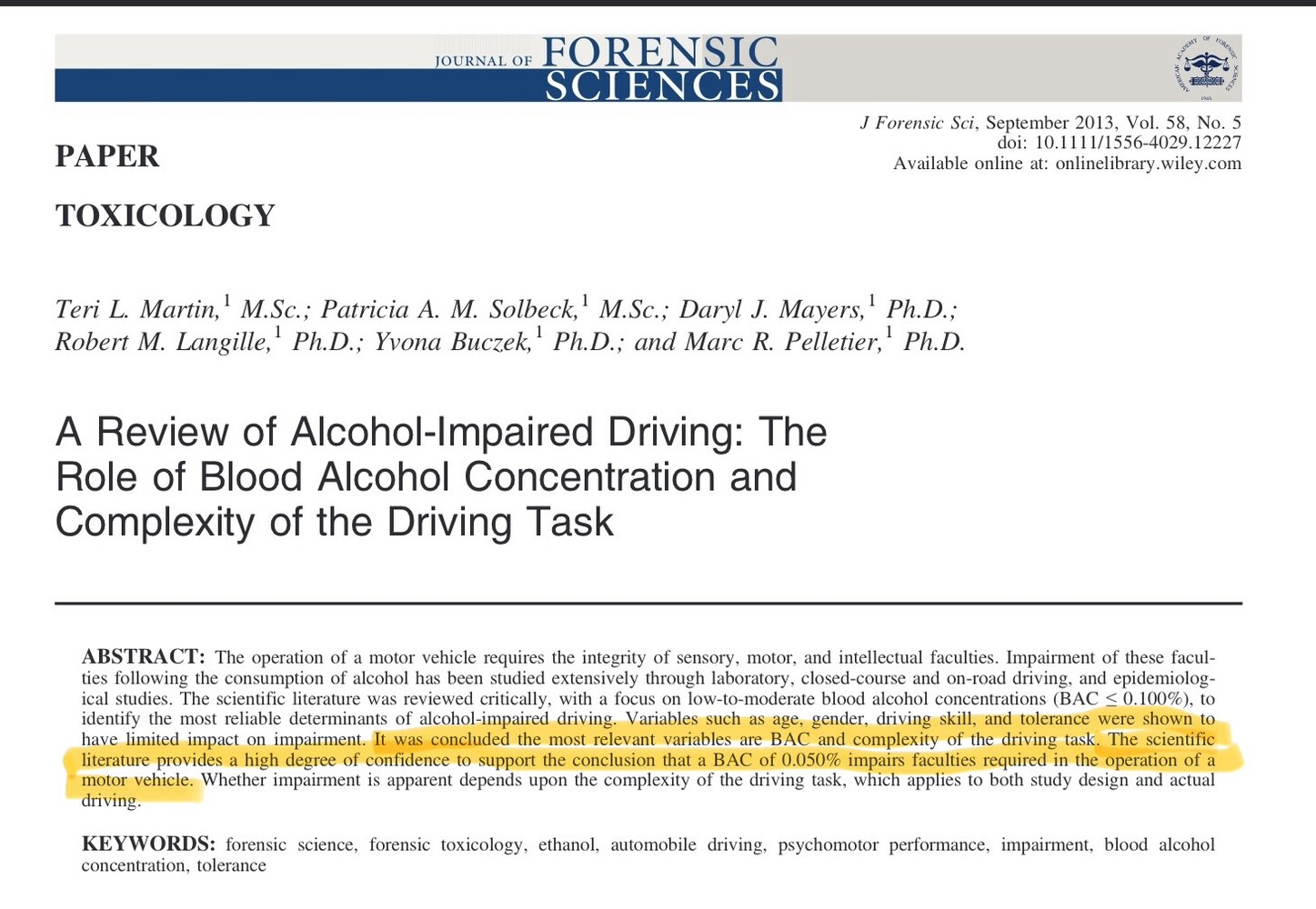
I was pleased that my colleagues continued my work after I retired and published a peer-reviewed study in the prestigious Journal of Forensic Sciences on this issue. The authors reviewed the scientific literature critically, focusing on low-to-moderate blood alcohol concentrations (BAC ≤ 0.100%), to identify the most reliable determinants of alcohol-impaired driving. Variables such as age, gender, driving skill, and tolerance were shown to have limited impact on impairment. It was concluded that the most relevant variables are BAC and the complexity of the driving task, and that “the scientific literature provides a high degree of confidence to support the conclusion that a BAC of 0.050% impairs faculties required in the operation of a motor vehicle.”
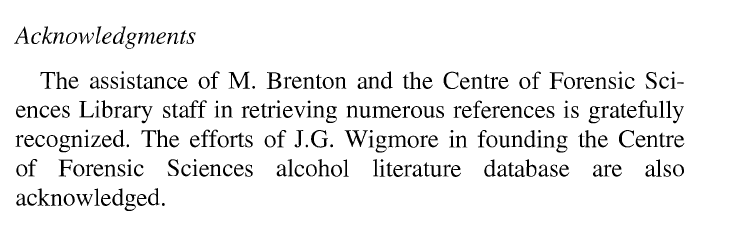 My colleagues who co-authored the study were Teri Martin, Pat Solbeck, Daryl Mayers, Rob Langille, and Yvona Buczek. They also acknowledged my assistance, noting that “the efforts of J.G. Wigmore in founding the Centre of Forensic Sciences alcohol literature database are also acknowledged.”
Conclusion
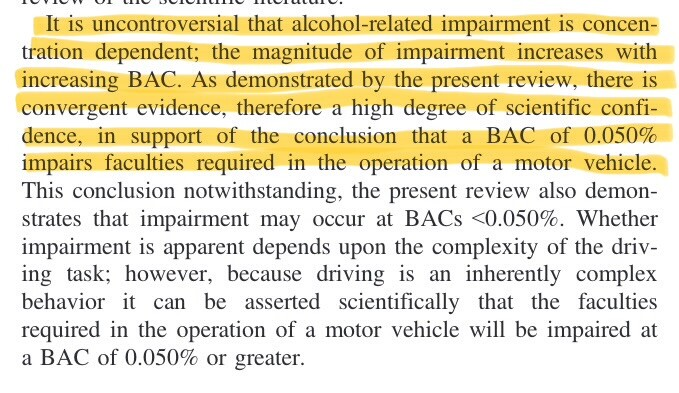 I agree with the conclusions of my former colleagues at the Centre of Forensic Sciences in Toronto. As they wrote, “alcohol-related impairment is concentration dependent; the magnitude of impairment increases with increasing BAC.” There is convergent evidence, and therefore a high degree of scientific confidence, that a BAC of 0.050% impairs the faculties required in the operation of a motor vehicle. Impairment may even occur at BACs below 0.050%.
Whether impairment is apparent depends on the complexity of the driving task — and because driving is an inherently complex behaviour, it can be asserted scientifically that the faculties required in the operation of a motor vehicle will be impaired at a BAC of 0.050% or greater. The legal driving BAC limit of 80 mg/100mL is a statutory threshold, not a scientific one — and the science on impairment sits well below the legal driving BAC limit.
References
- Martin, T. L., Solbeck, P. A. M., Mayers, D. J., Langille, R. M., Buczek, Y., & Pelletier, M. R. (2013). A review of alcohol-impaired driving: The role of blood alcohol concentration and complexity of the driving task. Journal of Forensic Sciences, 58(5), 1238–1250
- Wigmore, James G. Wigmore on Alcohol, 2e, Chapter 5, The Effect of Alcohol on Driving Ability, pp 301-391, University of Toronto Press, 2024
Expert Analysis on the Legal Driving BAC Limit and Impairment
Consult One of North America's Most Experienced Toxicology Experts
Jim Wigmore has testified in more than 700 criminal cases and his 70+ peer-reviewed articles are cited worldwide — including by the Supreme Court of Canada. If you need expert insight into impairment at low BACs, BAC calculation, or the science behind the legal driving BAC limit, contact him today.
Contact James Wigmore for Expert ConsultationPut 50 years of forensic expertise on your side. Reach out now for expert consultation.
FAQs on the Legal Driving BAC Limit
Is a driver impaired if their BAC is under 80 mg/100mL?
Yes. Numerous laboratory, closed-course, highway, and epidemiological studies show that at BACs of 50 mg/100mL and over, all drivers are impaired in their driving ability.
What is the legal driving BAC limit in Canada?
The statutory limit is 80 mg/100mL, but scientific research shows impairment begins at 50 mg/100mL and can occur even below that.
What happened in the 82 mg/100mL case?
The driver's BAC was 82 mg/100mL, which could fall below 80 given analytical variability, but the Crown said Wigmore would testify that impairment exists at 50 mg/100mL and above.
What did Justice O'Connor say?
"Mr. Wigmore has always said that there is impairment at BACs of 50."
What study did Wigmore's colleagues publish?
A peer-reviewed review in the Journal of Forensic Sciences concluding that a BAC of 0.050% impairs the faculties required to operate a motor vehicle.
Which variables were shown to have limited impact on impairment?
Age, gender, driving skill, and tolerance.
What are the most relevant variables for impairment?
BAC and the complexity of the driving task.
Can impairment occur below 50 mg/100mL?
Yes. The review demonstrated that impairment may occur at BACs below 0.050%, depending on the complexity of the driving task.
Recent News
50 over 50
A common misconception is that unless the BAC of the driver is over 80 mg/100mL,...
Read More
Man vs Machine and the Golden Rule of DUI Litigati...
I retired from the Centre of Forensic Sciences in 2005, and rather than testifying for...
Read More
Two Great Bookends for a Career
Brian O’Marra and I had had similar parallel careers which crossed several times over the...
Read More
Once More Into the Breach: Junkert Impaired Drivin...
Some DWI cases change the legal landscape forever. The Junkert case is one of them....
Read More