


Man vs Machine and the Golden Rule of DUI Litigation
I retired from the Centre of Forensic Sciences in 2005, and rather than testifying for the defence in two beer (Carter) cases, I decided to scientifically evaluate the accuracy of determining the BAC by using the sworn testimony of the drinking driver, or the results of a properly calibrated and tested evidential breath alcohol instrument. The question was simple: when the driver and the machine disagree, which one should the court believe? The machine won — and an alcohol tester sat at the centre of the reasoning.
“Buttressed by Wigmore” Chief Justice Beverley McLachlin, R vs St-Onge Lamoreau, October 13, 2011, commenting on how the crown attorney’s case was strengthened by James Wigmore
Man vs Machine
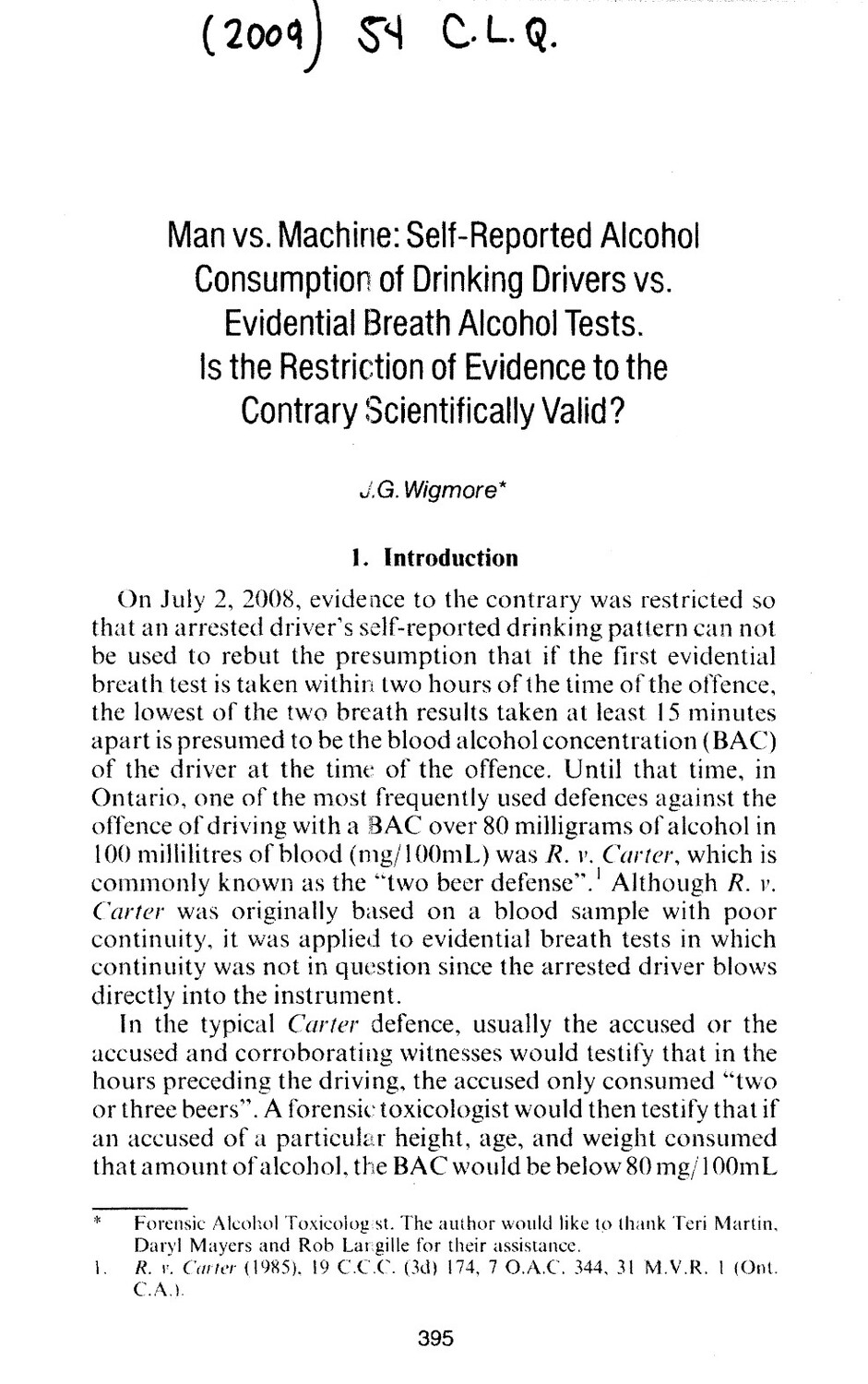 My 16-page article was published by the Criminal Law Quarterly, volume 54. On July 2, 2008, evidence to the contrary was restricted so that an arrested driver’s self-reported drinking pattern cannot be used to rebut the presumption that if the first evidential breath test is taken within two hours of the time of the offence, the lowest of the two breath results taken at least 15 minutes apart is presumed to be the blood alcohol concentration (BAC) of the driver at the time of the offence.
Until then, in Ontario, one of the most frequently used defences against the offence of driving with a BAC over 80 milligrams of alcohol in 100 millilitres of blood (mg/100mL) was R. v. Carter, commonly known as the “two beer defence.” Although R. v. Carter was originally based on a blood sample with poor continuity, it was applied to evidential breath tests in which continuity was not in question, since the arrested driver blows directly into the instrument.
In the typical Carter defence, the accused — or the accused and corroborating witnesses — would testify that in the hours preceding the driving, the accused only consumed “two or three beers.” A forensic toxicologist would then testify that if an accused of a particular height, age, and weight consumed that amount of alcohol, the BAC would be below 80 mg/100mL. The argument rested entirely on memory and self-report, never on the reading from an alcohol tester.
The Machine Wins
The Supreme Court of Canada cited my paper in their decision in R. v. St-Onge Lamoureux. The machine — evidential breath alcohol testing — wins. The alcohol tester is calibrated, tested, and indifferent to what the driver remembers or wishes to claim. A properly maintained alcohol tester does not have an off day.
The Golden Rule of DUI Litigation
 My dear, long-time colleague, Wayne Jones, described a case in Sweden, which I included in my study, of a 38-year-old woman who caused a minor motor vehicle collision in central Stockholm and had an Intoxilyzer 5000 test conducted, along with two blood samples collected at the police station. She showed little physical sign of alcohol intoxication.
The first blood sample showed a BAC of 256 mg/100mL. The driver claimed on the day in question she only consumed 1½ glasses of white wine at lunch. he alcohol tester and the blood samples told a very different story. The second blood sample was therefore analysed in triplicate and determined that the BAC was 244 mg/100mL, the lower result due in part to the loss of alcohol upon storage. DNA of the blood sample matched her DNA profile.
The case still went to trial, where the defence called an expert witness who stated that she was not an alcoholic and therefore should show greater physical intoxication at this BAC. The prosecutor did not call any expert testimony. The judge acquitted, and the case was appealed to the High Court. It was found that the Intoxilyzer result had been stored in the Intoxilyzer 5000 chip and, even though it was a deficient breath sample, the BAC was 226 mg/100mL.
The High Court unanimously convicted the driver, and three years later the Swedish Supreme Court declined to hear the appeal. Wayne Jones concluded:
“The lower court justices seem to have chosen to ignore a golden rule in DUI litigation, namely that what the suspect says he or she had drunk is not reliable evidence.”
Conclusion
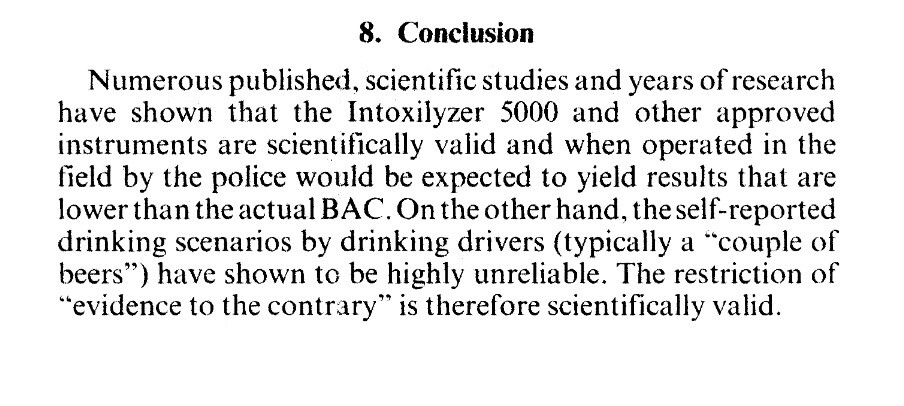 The conclusion of my study was as follows:
“Numerous published, scientific studies and years of research have shown that the Intoxilyzer 5000 and other approved instruments are scientifically valid and when operated in the field by the police would be expected to yield results that are lower than the actual BAC. On the other hand, the self-reported drinking scenarios by drinking drivers (typically a ‘couple of beers’) have shown to be highly unreliable. The restriction of ‘evidence to the contrary’ is therefore scientifically valid.”
In other words, an alcohol tester does not forget, does not round down, and does not have a reason to lie. The driver does. When the choice is between a person’s memory and a tested alcohol tester, the science is clear.
References
- Jones, A.W., “Are a Blood Alcohol Concentration of 256 mg/dl and Minimal Signs of Impairment Reliable Indications of Alcohol Dependence?” Medicine, Science and the Law, 34: 265, 1994
- Osgoode Hall Law School, University of York, “R v St-Onge Lamoureau: The Supreme Court of Canada upholds most of Parliament’s new over 80 drunk driving law”, November 14, 2012
- Wigmore, J.G., “Man vs Machine: Self-Reported Alcohol Consumption of Drinking drivers vs. Evidential Breath Alcohol Tests. Is the Restriction of Evidence to the Contrary Scientifically Valid?”, Criminal Law Quarterly, 54: 395-410, 2009
Expert Analysis on Alcohol Testers and DUI Litigation
Consult One of North America's Most Experienced Toxicology Experts
Jim Wigmore has testified in more than 700 criminal cases and his 70+ peer-reviewed articles are cited worldwide — including by the Supreme Court of Canada. If you need expert insight into alcohol tester accuracy, evidence to the contrary, or BAC calculation, contact him today.
Contact James Wigmore for Expert ConsultationClick here to discuss toxicology cases, research questions, or litigation support.
FAQs on Alcohol Testers and DUI Litigation
What is the "two beer defence"?
It is the R. v. Carter defence, in which an accused testifies they drank only "two or three beers," and a toxicologist testifies that such an amount would keep their BAC below 80 mg/100mL.
Why was evidence to the contrary restricted in 2008?
Because self-reported drinking has proven highly unreliable, while approved instruments like the Intoxilyzer 5000 are scientifically valid and tend to read lower than actual BAC in the field.
What did the Supreme Court of Canada decide in R. v. St-Onge Lamoureux?
It upheld most of Parliament's new over-80 law, restricting evidence to the contrary and effectively siding with the machine.
What was the Swedish case about?
A 38-year-old woman claimed she drank 1½ glasses of white wine, but blood samples showed 256 and 244 mg/100mL, and a stored Intoxilyzer result showed 226 mg/100mL.
What is the Golden Rule of DUI litigation?
What the suspect says they drank is not reliable evidence.
Why did the lower Swedish court acquit?
The defence expert claimed she was not an alcoholic and should have shown greater physical intoxication, and the prosecutor called no expert testimony.
What happened on appeal in Sweden?
The High Court unanimously convicted the driver, and the Swedish Supreme Court declined to hear the appeal three years later.
What makes an alcohol tester more reliable than a driver's statement?
It is properly calibrated and tested, yields results expected to be lower than actual BAC, and is unaffected by memory, denial, or self-interest.
What did the author's study conclude?
That the Intoxilyzer 5000 and other approved instruments are scientifically valid, that self-reported drinking is highly unreliable, and that restricting evidence to the contrary is scientifically valid.
Who was Wayne Jones?
A long-time colleague of the author who described the Swedish case and coined the Golden Rule of DUI litigation.
Recent News

Man vs Machine and the Golden Rule of DUI Litigati...
I retired from the Centre of Forensic Sciences in 2005, and rather than testifying for...
Read More
A Lead Has Opened Up: Breathalyzer Law
About a year after I retired from the Centre of Forensic Sciences, I had lunch...
Read More
Impaired Driving Cases: Rats Don’t Drive
Impaired driving prosecutions require expert testimony grounded in human physiology, not animal studies. Occasionally humour...
Read More
A Toxicology Definition Perspective: Does Gastric ...
Gastroesophageal Reflux Disease (GERD) is a digestive disease that occurs in approximately 10 to 20%...
Read More