


Ultra High Rate of Alcohol Elimination in Drinking Drivers
Understanding alcohol elimination rates is critical for forensic toxicologists, defence lawyers, and crown attorneys. When a drinking driver provides a blood sample hours after driving, experts must back-calculate their blood alcohol concentration at the time of the offence. The standard alcohol elimination rate of 15 mg/100mL per hour applies to social drinkers, but heavy drinkers tell a different story. My 50 years of experience at the Centre of Forensic Sciences in Toronto has shown that chronic drinkers eliminate alcohol much faster than casual drinkers – sometimes shockingly so.

Although alcohol is a legal drug it is often referred to as the Jekyll and Hyde of the drug world because moderate drinking, such as one to two glasses of wine daily, is considered harmless, whereas heavy drinking and drunkenness wreck people’s lives and lead to premature deaths. One of the biggest societal problems of irresponsible drinking is in connection with alcohol-impaired driving and associated road-traffic crashes.
A.W. Jones, WOA 2e, p xxxvi, 2024

A.W. Jones: The World's Top Forensic Alcohol Toxicologist
Although the world’s top forensic alcohol toxicologist, A.W. (Wayne) Jones was born in Wales, he spent most of his professional life in the forensic laboratory in Sweden. His groundbreaking research on alcohol elimination rates in drinking drivers has shaped how courts understand impaired driving cases across North America and Europe. The study I am about to describe comes from his 2008 paper in the International Journal of Legal Medicine.
Alcohol Elimination Rates in Drinking Drivers
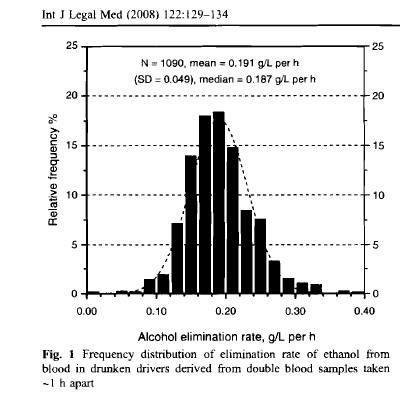 An analysis was conducted of the BACs of double blood samples collected from drinking drivers in Sweden, approximately one hour apart. A total of 1,090 drivers participated in the study. The mean alcohol elimination rate was 19 mg/100mL per hour. This is not unexpected, as drinking drivers are typically heavier drinkers than social drinkers, who have an average alcohol elimination rate of 15 mg/100mL per hour.
The 97.5 percentile for the rate of alcohol elimination in drinking drivers ranged between 11 and 31 mg/100mL per hour. This wide range demonstrates why forensic experts cannot simply apply a standard elimination rate to every case. Each driver’s metabolic profile is unique.
Only 21 drivers (2.2%) had an apparent rate of alcohol elimination of less than 10 mg/100mL per hour. This unusually slow rate may have been due to the drivers being in the rising or plateau phases of the BAC curve rather than the elimination phase. When a driver is still absorbing alcohol, back-calculation becomes much more complex.
Ultra High Alcohol Elimination Rates
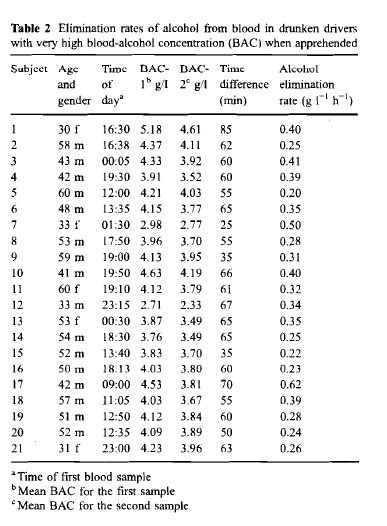 The study also determined the rates of alcohol elimination in 21 drivers who had the highest alcohol elimination rates, as shown in the attached table. These ultra-high alcohol elimination rates occurred in drivers with a BAC of between 271 and 518 mg/100mL, with a mean BAC of 405 mg/100mL. To put this in perspective, the legal driving limit in Canada is 80 mg/100mL. These drivers had BACs five to six times above the legal limit.
The mean rate of alcohol elimination in these extreme cases was 33 mg/100mL per hour, with a remarkable range of 20 to 62 mg/100mL per hour. The driver with the highest alcohol elimination rate – 62 mg/100mL per hour – was a 42-year-old male who provided his first blood sample at 9:00 a.m. with a BAC of 453 mg/100mL. His second sample, taken 70 minutes later, showed a BAC of 381 mg/100mL.
These ultra-high alcohol elimination rates have significant implications for forensic back-calculations. If a defence expert assumes a slow elimination rate of 15 mg/100mL per hour, the calculated BAC at the time of driving could be artificially inflated. Conversely, assuming an ultra-high rate could benefit the defence. The truth lies in the individual driver’s drinking history.
Conclusion
Those who drink alcohol to reach a BAC exceeding 300 mg/100mL (3.0 g/L) have probably been drinking continuously for several days or weeks. This pattern of chronic drinking is associated with the development of cellular and functional tolerance, so that people can appear relatively sober and are sufficiently alert to walk and attempt to drive a motor vehicle – despite having BACs that would incapacitate a social drinker.
Prolonged heavy drinking also leads to dispositional or metabolic tolerance, which can account for the faster rate of alcohol elimination and give a steeper slope in the post-peak BAC elimination phase. For forensic experts, understanding these ultra-high alcohol elimination rates is essential for accurate back-calculation and fair courtroom testimony.
Reference
Contact a Forensic Expert Who Understands Alcohol Elimination
Consult Canada's Leading Forensic Toxicologist
James Wigmore has testified in over 700 criminal cases involving alcohol elimination rates, back-calculation, and impaired driving defence. With 50 years of experience at the Centre of Forensic Sciences in Toronto and authorship of Wigmore on Alcohol, he provides expert insight into the science of alcohol metabolism for legal professionals.
Contact James Wigmore TodayPut 50 years of forensic alcohol expertise on your side. Reach out now for expert consultation.
FAQs on Alcohol Elimination Rates
What is the standard alcohol elimination rate for social drinkers?
Social drinkers typically eliminate alcohol at an average rate of 15 mg/100mL per hour.
What is the mean alcohol elimination rate for drinking drivers in the Swedish study?
The mean rate was 19 mg/100mL per hour, based on 1,090 drivers.
What was the highest alcohol elimination rate recorded in the study?
One driver had an elimination rate of 62 mg/100mL per hour – more than four times the social drinker average.
What BAC levels did the ultra-high elimination drivers have?
Their BACs ranged from 271 to 518 mg/100mL, with a mean of 405 mg/100mL. The legal limit in Canada is 80 mg/100mL.
Who conducted this research on alcohol elimination?
A.W. (Wayne) Jones, the world's top forensic alcohol toxicologist, published this study in the International Journal of Legal Medicine in 2008.
What percentage of drivers had an elimination rate below 10 mg/100mL per hour?
Only 21 drivers (2.2%) had rates below 10 mg/100mL per hour, possibly due to being in the absorption phase.
Why do chronic heavy drinkers have faster alcohol elimination rates?
Prolonged heavy drinking leads to dispositional or metabolic tolerance, which increases the rate of metabolism.
What is the 97.5 percentile range for alcohol elimination in drinking drivers?
The range was between 11 and 31 mg/100mL per hour.
How does functional tolerance affect heavy drinkers?
Chronic drinkers can appear relatively sober and remain alert enough to walk and drive despite extremely high BACs.
Where did A.W. Jones conduct most of his professional work?
Although born in Wales, he spent most of his professional life in a forensic laboratory in Sweden.
Recent News

ALL RISE! The Supreme Court of Canada and the Two ...
The two beer defence – also known as the Carter defence – was a legal strategy used...
Read More
Cannabis and Alcohol and Driving: 1+1 =3?
When it comes to driving impairment, the combination of alcohol and cannabis is far more dangerous than...
Read More
A Real Wingding of a Conference! The Joint SAFS, M...
In September 2004, hundreds of forensic scientists from across North America gathered in Orlando for a joint...
Read More
Ultra High Rate of Alcohol Elimination in Drinking...
Understanding alcohol elimination rates is critical for forensic toxicologists, defence lawyers, and crown attorneys. When a drinking...
Read More